Pressure washing vs soft washing: which one to use, and when
Published: 24 August 2026 · By Shine Wise Cleaning Team, Founder of Shine Wise Cleaning · Updated: 24 August 2026
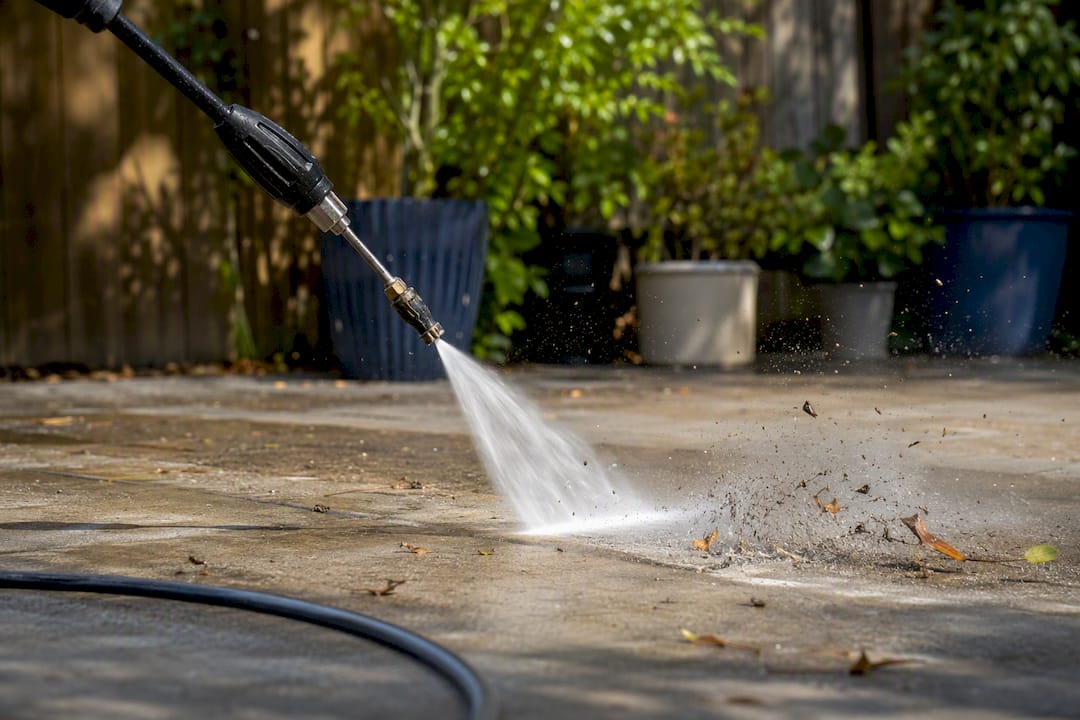
High-pressure washer nozzle spraying driveway
Soft wash for anything delicate or biological, like a mould-streaked roof or algae-stained siding. Pressure wash for hard, durable surfaces carrying physical grime, like a concrete driveway or an oil-stained garage floor. That's the whole decision in one line.
- Roof with black streaks? Soft wash, always.
- Concrete driveway with tyre marks? Pressure wash.
- Unsure which camp your job falls into? The checklist further down sorts it out in three steps, and the risk section explains what goes wrong when people guess.
Key Takeaways
The right exterior cleaning method depends entirely on what's on the surface, not on preference: soft wash for biological growth on delicate materials, pressure wash for physical grime on durable surfaces.
| Point | Details |
|---|---|
| Match method to contamination | Soft wash kills algae, mould, and mildew at the root; pressure wash physically strips dirt, oil, and grime. |
| Know the pressure difference | Soft wash runs under 500 PSI; heavy-duty pressure washing runs 2,500 to 4,000 PSI. |
| Protect roofs and cladding | High pressure on shingles or siding risks granule loss, stripped paint, and water forced behind panels. |
| Soft wash lasts longer on biology | Killing spores rather than blasting stains means roof results can hold for four to six years. |
| Hire a pro for risk and runoff | Shine Wise Cleaning runs police-checked, checklist-driven pressure and soft-wash jobs with eco-friendly options across Canberra and Perth. |
Table of Contents
- Pressure washing vs soft washing: what pressure washing actually is
- What is soft washing, and why does it last longer?
- How do pressure washing and soft washing actually compare?
- Which method suits your surfaces? A quick surface guide
- What mistakes cause the most damage, and how do you avoid them?
- Should you DIY it or call a professional?
- A three-step decision checklist you can use right now
- Pressure washing vs soft washing: the definitions that matter
- Why we treat "clean" and "long-term clean" as different jobs
- Get the right method matched to your property, not guessed at
- Sources
- FAQ
Pressure washing vs soft washing: what pressure washing actually is
Pressure washing is mechanical cleaning. Water gets forced through a narrow nozzle at high velocity, and that force alone strips dirt, grime, and stains off a surface. No chemistry required, though many operators add a degreaser for tough jobs.
Working pressure for home and commercial jobs typically sits between 2,500 and 4,000 PSI for heavy duty tasks like driveways, warehouse floors, and fleet vehicles. PSI measures the force behind the water. GPM (gallons per minute) measures volume, and it matters more than most people realise on large flatwork. A high-GPM machine clears grime off a wide driveway faster than a high-PSI, low-GPM unit, because it's covering ground, not just blasting one spot harder.
Hot water rigs earn their keep on grease. A cold pressure washer can push oil around a surface without lifting it. Add heat, and the wash breaks down grease molecules properly, which is why restaurant exteriors, loading docks, and commercial kitchens almost always get cleaned with hot water equipment.
- Surface cleaners (the spinning wand attachments) give even coverage on concrete without stripe marks.
- Nozzle angle changes everything: a 0 degree tip is a cutting tool, a 40 degree tip is closer to a rinse.
- Eye protection, closed footwear, and non-slip boots aren't optional extras on a wet job site.
Pro Tip: If you're renting a machine, ask for the GPM rating, not just the PSI. A 3,000 PSI unit with poor GPM will take twice as long on a big driveway as a slightly weaker machine with better flow.
What is soft washing, and why does it last longer?
Soft washing swaps force for chemistry. It runs at under 500 PSI, which is barely more pressure than a garden hose with a decent nozzle. The actual cleaning happens through a mix, usually sodium hypochlorite paired with a surfactant that helps the solution cling to vertical surfaces and cracks instead of running straight off.
Soft washing sprayer applying solution on roof
That surfactant does the quiet work. It lets the chemical sit on the surface long enough (the "dwell time") to kill algae, mould, mildew, and lichen at the root, rather than just knocking the visible growth off. That's the real difference in outcomes: a pressure-washed roof looks clean for a season, while a soft-washed roof often stays clean for four to six years because the spores causing regrowth are gone, not just displaced.
Equipment-wise, soft wash setups run either through downstream chemical injection off a standard pressure washer using a black soap nozzle, or through a dedicated low-pressure pump. Matching pump size to the nozzle orifice keeps the mix consistent and stops the machine running harder than the job needs.
- Under 500 PSI at the surface, chemistry does the work, not force.
- Dwell time (letting the mix sit) matters more than scrubbing pressure.
- Runoff control and plant protection aren't optional. Pre-wetting garden beds and using a neutraliser afterwards prevents chemical damage to vegetation.
Pro Tip: Never soft wash on a windy day. Overspray drift onto a neighbour's garden or your own lawn is one of the most common and preventable callbacks in the trade.
How do pressure washing and soft washing actually compare?
Put them side by side and the differences are about method, not just intensity.
| Factor | Pressure washing | Soft washing |
|---|---|---|
| Typical working pressure | 2,500-4,000 PSI | Under 500 PSI |
| How it cleans | Mechanical force | Chemical treatment with dwell time |
| Best against | Embedded dirt, oil, gum, tyre marks | Algae, mould, mildew, lichen |
| Typical result longevity | Weeks to months on organic growth | Often four years on roofs |
| Main risk | Surface damage, water intrusion | Chemical drift, plant or metal damage without controls |
Pressure washing's biggest weakness shows up on anything biological. Blast algae off a roof with force and you've cleaned the visible layer, but the spores are still in the substrate, and the growth comes back within a season. Soft washing's weakness is the opposite: chemistry does nothing against embedded oil stains or years of compacted grime on concrete. No amount of dwell time lifts a tyre mark.
Plenty of professionals don't pick one system and stick with it. Many run downstream injection setups on the same rig they use for high-pressure work, switching nozzles depending on the surface. It's common for one property to get both treatments: soft wash on the roof and siding, pressure wash on the driveway and paths, done in the same visit.
The practical takeaway is simple. The right method is decided by the surface and the contamination sitting on it, never by which machine happens to be in the van.
Which method suits your surfaces? A quick surface guide
- Roofs. Soft wash is the strong default for asphalt shingles and most tiled roofs. High pressure on shingles causes granule loss, which shortens the roof's life and can void a manufacturer's warranty outright.
- Cladding, timber, and painted surfaces. Vinyl siding, weatherboard, and painted exteriors respond well to soft wash. Force water at these surfaces and you risk driving moisture behind panels, stripped paint, and gouged timber.
- Decks and timber structures. Treat these cautiously. A lower pressure setting combined with a wood-safe cleaning product often works better than either method run at full strength, and a two-step approach (chemical treatment, then a light rinse) protects the grain.
- Solar panels, screens, and delicate fixtures. These need specialist, low-impact cleaning or manufacturer-approved products only. A standard pressure washer nozzle can crack a panel or bend a screen frame in seconds.
What mistakes cause the most damage, and how do you avoid them?
Most damage complaints trace back to the same handful of mismatches. Roof granule loss from high pressure on shingles is the most expensive one, because it often isn't obvious until the next heavy rain shows leaks. Stripped paint and gouged stucco usually come from holding a pressure wand too close, or using too aggressive a nozzle angle on a soft substrate.
Water forced behind cladding is sneakier still. It doesn't show up as damage on the day. It shows up as mould and rot months later, once moisture has been trapped behind the panel.
- Cold water on grease spreads the stain rather than lifting it, wasting time and detergent.
- Overpressuring a delicate material (old mortar, soft render, ageing timber) can cause damage that's invisible until it fails later.
- Skipping the pre-rinse on garden beds before applying soft wash chemicals is a common and avoidable cause of plant burn.
- Ignoring wind direction lets chemical runoff drift onto surfaces or gardens well outside the work area.
Pro Tip: Before starting any job, walk the property and note every garden bed, pond, and drain within splash range. Five minutes of planning saves a much longer conversation with an unhappy neighbour.
Should you DIY it or call a professional?
DIY makes sense for small, hard-surface jobs. If it's a section of paved path, and you've got the correct nozzle, a sensible pressure setting, and proper eye and foot protection, a rented pressure washer will do the job safely.
Hand it to a professional once the job involves a roof, steep or awkward access, a mixed-material façade, a warranty-sensitive surface, or any situation needing controlled runoff. Soft washing in particular isn't automatically the "safe" option just because the pressure is lower. Managing chemical runoff and protecting nearby plants properly requires real skill, and professionals also weigh site-level factors like material age, sun exposure, wind, and drainage before choosing a method, something a one-off DIY job rarely accounts for.
Two homes that look identical from the street can call for two different treatment plans once you factor in how exposed each roof is, how the render has aged, and where runoff will actually end up.
Shine Wise Cleaning runs police-checked teams on every pressure cleaning and soft-wash job, working from a set checklist rather than guesswork, with eco-friendly chemical options available for properties near gardens or waterways.
A three-step decision checklist you can use right now
- Identify the surface and its condition. Is it a roof, cladding, timber deck, or concrete? Is it old, worn, or already showing wear?
- Identify what's actually on it. Biological growth (algae, mould, lichen) points one way. Grease, embedded dirt, paint, or rust points the other.
- Apply the rule of thumb. Delicate or biological, soft wash. Durable and greasy or physically embedded, pressure wash. If the job mixes both, or the surface is high-risk (roof, steep access, ageing render), get a professional quote rather than guessing.
Pressure washing vs soft washing: the definitions that matter
Pressure washing is the mechanical removal of dirt, grime, and stains using water forced through a nozzle at high velocity, typically in the thousands of PSI for serious jobs. It relies almost entirely on physical force. No chemical is required, though degreasers get added for oil and grease.
Soft washing is a low-pressure cleaning method, generally under 500 PSI, that uses a chemical solution (commonly sodium hypochlorite combined with a surfactant) to break down and kill biological growth. The cleaning happens through the chemistry sitting on the surface for a set dwell time, not through force.
These aren't two intensities of the same tool. They're two different approaches solving two different problems. Pressure washing shifts physical material off a surface: dirt, gum, oil, loose paint. Soft washing kills living organisms on a surface: algae, mould, mildew, lichen, and the spores that cause them to return.
Confusing the two is where most DIY damage comes from. Someone with a rented pressure washer and a roof full of black streaks reaches for the highest setting because that's the tool they have, not because it's the right tool for the growth on the tiles. The method should be chosen by what's actually growing or embedded on the surface, and by what the surface itself can tolerate, not by whichever machine is easiest to hire for the weekend.
Pressure washing vs soft washing: the definitions that matter, overview diagram
Why we treat "clean" and "long-term clean" as different jobs
We've learned that the quickest visual fix and the longest-lasting result aren't always the same job. A quick blast can make a roof look clean for a month, but if the spores are still there, the streaks come back before the invoice is paid off. That's why our checklist-driven approach favours protecting the material and controlling runoff over chasing the fastest result. Every job runs through police-checked teams, with eco-friendly options where a property sits near gardens or waterways. If you're unsure which method your property needs, we're happy to run an on-site assessment before recommending anything.
- Shine Wise Cleaning Team
Get the right method matched to your property, not guessed at
Shine Wise Cleaning takes the guesswork out of choosing between soft wash and pressure wash by sending police-checked teams who assess the surface before they touch a nozzle to it. Every job runs off a checklist built for landlords, agents, and property managers, and every crew carries eco-friendly chemical options for jobs near gardens, drains, or waterways.
Shinewisecleaning
Whether it's a mould-streaked roof crying out for a gentle chemical treatment or a driveway that needs real mechanical force to shift years of grime, our pressure cleaning service covers driveways, paths, and patios across Canberra and Perth, and we'll happily pair it with a soft wash where the roof or siding calls for it. Browse our full range of cleaning services or request a quote today to get the right method matched to your property from the start.
Sources
- Eco-safe softwashing Australia (Evolving Elements)
- Soft wash vs pressure wash (Pumptec blog)
- How pros choose soft washing vs pressure washing (Eclipse Power Wash)
FAQ
Is soft washing better than pressure washing?
Neither is universally better. Soft washing wins on biological growth and delicate surfaces because it kills the root cause and lasts longer; pressure washing wins on embedded dirt, oil, and hard surfaces where mechanical force is needed.
What should you not pressure wash?
Avoid high pressure on asphalt shingle roofs, ageing render, loose mortar, delicate timber, solar panels, and screens. These surfaces risk granule loss, cracking, or structural damage from force alone.
What PSI is considered soft wash?
Soft washing typically runs under 500 PSI at the surface, relying on chemical dwell time rather than force to clean.
Do you rinse the roof after soft washing?
A light rinse is common practice to remove residual chemical and dead organic matter, though some treatments are left to break down naturally. A professional will factor this into the neutralising step to protect gutters and garden beds below.
Can I combine both methods on one property?
Yes, and many professionals do exactly that. A typical job might soft wash the roof and siding while pressure washing the driveway and paths in the same visit, since each area usually carries different contamination.
Recommended
Related services
Ready to book your clean?
Free quote · No obligation · Canberra & Perth
Related articles
Deep Cleaning Canberra: When, Why & What to Expect
A deep clean goes far beyond the weekly tidy — here's everything Canberra homeowners and renters need to know about when to book one, what it covers, and how to make the most of the service.
Read articleBuy a water fed pole or hire a pro window cleaner?
Decide between buying a water fed pole for DIY window cleaning or hiring professionals for a guaranteed, streak-free finish. Learn more!
Read article