
Removing pet urine from carpet for good
Published: 15 August 2026 · By Shine Wise Cleaning Team, Founder of Shine Wise Cleaning · Updated: 18 August 2026
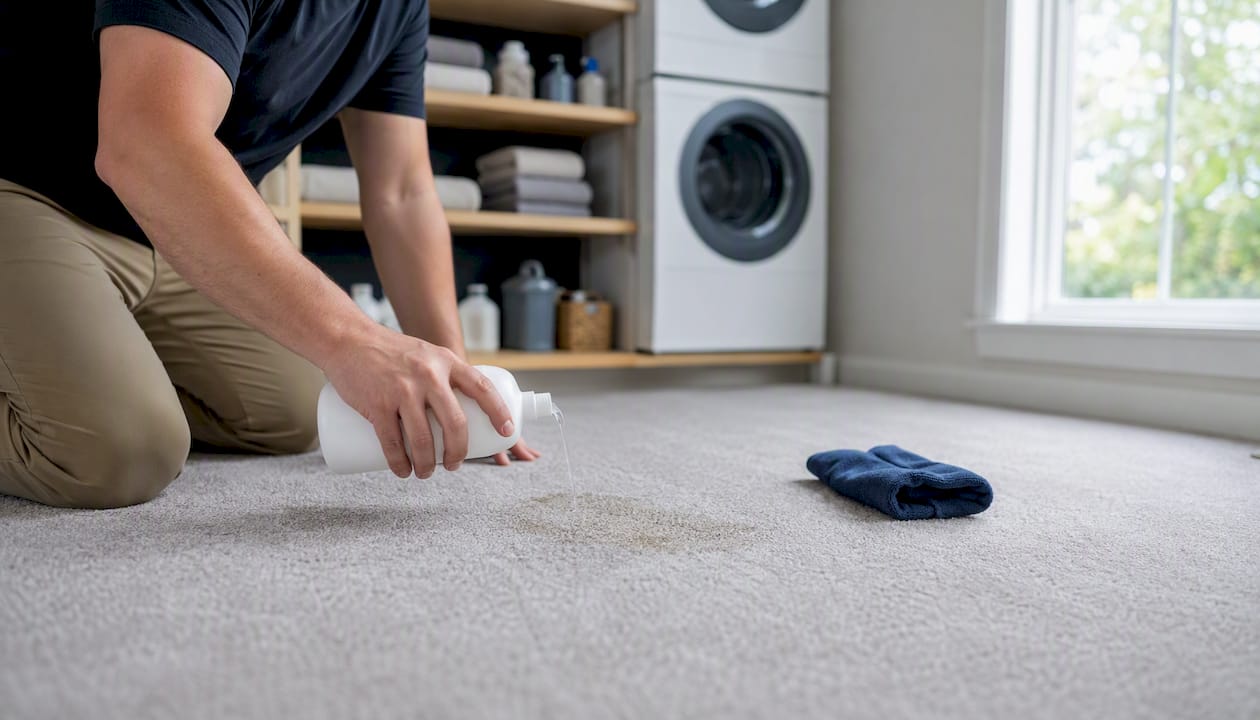
Hands applying cleaner on carpet urine stain
Yes, you can remove pet urine from carpet permanently, and in most cases you don't need a professional to do it. The fix is an enzymatic cleaner applied to the full depth of the contamination, not a splash on the surface. Uric acid crystals sit in the fibres, the backing, and sometimes the pad underneath, and only enzymes break those crystals down rather than masking them.
The first ten minutes matter more than anything else you'll do. Blot the spot firmly with white towels (stand on them if the accident is large), skip any heat or steam, and hold off on vinegar or bicarbonate until you've read why they're a temporary patch rather than a fix. Once you've pulled out as much liquid as you can, an enzyme cleaner goes down and gets time to work.
- Blot, don't rub, using plain white cloths or paper towel, pressing hard enough to draw liquid up rather than push it down.
- Skip heat, fans on high, or any warm appliance near the spot until the enzyme treatment is finished.
- Apply the enzyme cleaner once you've blotted the area dry, pouring rather than spraying so it actually saturates.
Pro Tip: If the smell is still there after repeated enzyme treatments, or the same patch keeps getting hit again and again, stop treating it yourself. That's the point where pad-level contamination or a training issue needs a proper look, ideally from a carpet cleaner trained to IICRC standards.
Key takeaways
Enzymatic cleaning applied to the full depth of contamination, including the pad when needed, is the only method that removes pet urine odour permanently rather than masking it.
| Point | Details | | --- | --- | | Blot first, always | Press liquid out with white towels before applying any product; never rub or scrub the stain. | | Enzyme is the permanent fix | Vinegar and bicarbonate help temporarily, but only enzymatic cleaners break down uric acid crystals for good. | | Match dwell time to depth | Fresh stains need 12 to 24 hours covered with plastic; set-in, pad-level stains need 24 to 48 hours. | | Avoid heat and harsh chemicals | Steam sets the odour in before treatment, and bleach or ammonia can worsen staining and attract repeat marking. | | Know when to call a pro | Persistent smell after two full treatments or subfloor damage calls for professional extraction, such as Shinewisecleaning's carpet steam cleaning. |
Table of Contents
- Why urine soaks in: what it does to carpet, pad and subfloor
- What you need before you start treating a stain
- How do you get pet urine out of carpet when it's fresh?
- How do you remove old, dried-in urine stains from carpet?
- What if urine soaked through to the subfloor?
- What should you never do to a urine stain?
- When should you call a professional carpet cleaner?
- Why professionals often succeed where repeat DIY attempts fail
- How do you stop pets marking the same spot again?
- If you'd rather leave it to the pros
- Sources
- FAQ
Why urine soaks in: what it does to carpet, pad and subfloor
Urine doesn't sit politely on top of your carpet fibres. It travels. Liquid follows gravity and capillary action down through the pile, through the woven backing, and into the foam pad beneath, spreading sideways as it goes, which is why a stain that looks the size of a saucer on the surface can cover a patch three times that size once it hits the pad.
That's the mechanical problem. The chemical one is worse. Fresh urine contains urea, which breaks down as it dries into uric acid crystals. These crystals are the actual source of the smell, and they're almost insoluble in water. Vinegar and bicarbonate of soda can help with a fresh stain and are worth reaching for as a first pass, but neither one dissolves the crystals themselves. Once humidity rises, whether from a humid day, a steam clean, or even someone walking across the carpet in bare feet, the crystals rehydrate and the odour comes straight back, according to guidance on cleaning pet urine without the smell returning.
There's a behavioural layer here too. Urine carries pheromone markers, and pets read those markers as a signal that a spot is a legitimate toilet. Leave the pheromones intact, even if the visible stain is gone, and you're inviting a repeat accident in the exact same square foot of carpet, a pattern PetMD flags as a common reason "cleaned" spots get hit again.
Picture the contamination as layers, not a single spot:
- Fibre level: visible staining and most of the surface odour, usually the easiest layer to treat.
- Backing level: where liquid starts spreading laterally, often wider than the visible mark on top.
- Pad level: where uric acid concentrates and where surface-only treatments (vinegar, bicarb, a quick carpet shampoo) routinely fail because the product never reaches that far down.
What you need before you start treating a stain
Getting this right the first time saves you a second and third attempt later, so it's worth five minutes of preparation before you touch the carpet.
- Gather an enzymatic (bio-enzymatic) pet urine cleaner labelled specifically for enzyme action, not a generic carpet shampoo.
- Set aside plain white cloths or paper towels; coloured fabric can transfer dye onto damp carpet.
- Have plastic wrap or a plastic sheet plus something heavy (books, a tray) to weigh it down over treated areas.
- Grab a UV or blacklight torch if you have access to one, useful for finding stains you can't see or smell yet.
- A carpet syringe or a clean turkey baster is handy for pad-level jobs, though not essential for a fresh surface stain.
- Keep a small fan nearby for the drying stage, but not for use during the enzyme's active period.
Before you pour anything onto a visible section of carpet, dab a small hidden patch (inside a wardrobe or under furniture) with the enzyme cleaner and check after ten minutes for colour change. Ventilate the room, wear gloves if you're using a stronger commercial product, and never combine bleach or ammonia with peroxide or an enzyme cleaner. Mixing cleaning chemicals like that can produce toxic fumes, and it also destroys the enzymes before they've had a chance to work.
Pro Tip: Do a full blacklight sweep of the room before you start, and mark every spot that fluoresces with a bit of masking tape. A blacklight inspection routinely turns up two or three extra patches for every one you knew about, and treating only the obvious spot leaves pheromone traces sitting right next to it.
Blacklight revealing hidden urine stains on carpet
How do you get pet urine out of carpet when it's fresh?
Fresh accidents are the easiest win in this whole process, provided you move fast and resist the urge to scrub.
- Blot immediately with a stack of white towels, pressing down with your body weight if you have to. Stand on the towels for thirty seconds at a time rather than rubbing back and forth.
- If you need to loosen dried edges, dab (don't pour) a little cold water, then blot again. Never use hot water on a fresh stain; heat sets protein into the fibres.
- Once the area is just damp rather than wet, pour the enzyme cleaner directly onto the stain, covering an area at least twice the size of what's visible, since urine spreads wider under the surface than it shows on top.
- Cover the treated patch with plastic wrap and weigh it down. This keeps the product from drying out early. Enzymes only work while they're wet, and covering the area is the step most people skip, according to [enzyme cleaner guidance](https://enzymecleaners.com/pet-stain-removal/dog-pee-smell-carpet) on why plastic-wrap coverage matters.
- Leave it for the full contact window, then remove the cover, blot up the excess, and let the area air dry naturally.
Pro Tip: Use only white cloths through the whole process, and once the carpet is fully dry, get down close and sniff. Warmth brings any remaining odour back to the surface, so a spot that seems fine on a cool morning can still smell faintly by afternoon. Repeat the enzyme step if you catch anything at all.
How do you remove old, dried-in urine stains from carpet?
Set-in urine behaves differently to a fresh accident because the crystals have already formed and the contamination has usually reached the pad. Treating only the top of the carpet on one of these spots is close to a waste of time.
Diagram of pet urine penetration in carpet layers
Start by rehydrating the area with cold water, working it in gently rather than flooding the surface. This softens the crystals and helps the enzyme reach them. Once the spot is evenly damp, apply the enzyme cleaner generously, aiming to saturate down to the pad rather than lightly coating the fibres. Retail products and professional-strength solutions differ in concentration, but success depends far more on how much product you use and how long you leave it than on the label, a point industry guidance on enzyme saturation makes clear: pour to saturate, don't lightly mist.
For genuine pad-level contamination, the injection method gets product to where a surface pour can't reach.
- Use a carpet syringe or a clean turkey baster to draw up enzyme cleaner.
- Insert it through the pile at several points across the stained area and push the plunger slowly, forcing liquid down through the backing toward the pad.
- For heavily soaked spots, pull the carpet back from the tack strip if it's loose enough, and pour the enzyme cleaner directly onto the exposed pad.
- Lay the carpet back down, cover with plastic, and weigh it in place for the full dwell time.
| Contamination size | Product volume | Dwell time | | --- | --- | --- | | Small, surface-only | A small amount appropriate for the area | A day or so | | Large or set-in, pad affected | A larger amount sufficient to saturate the pad | About one to two days |
A single treatment often isn't enough on a deeply soaked spot. Deep pad contamination usually needs enzyme saturation repeated with a full 24 to 48 hour dwell time on each attempt, and rushing the second round is the most common reason a stubborn spot never fully clears.
If the smell is still there after two thorough pad saturations, or you notice visible staining or softening on the underside of the carpet when you peel it back, stop. That's a subfloor issue, and it needs a different approach entirely.
What if urine soaked through to the subfloor?
A few signs tell you the contamination has gone past the pad. A persistent, sour smell that doesn't fade even after drying is the first clue. Dark staining on the underside of the pad or carpet backing is the second. A faint mustiness or any softness underfoot on a wood subfloor is the third, and that last one needs attention quickly before it turns into rot.
For a wood subfloor:
- Soak the affected section with enzyme cleaner and let it sit for the full dwell period.
- Allow the wood to dry completely, which can take several days depending on ventilation.
- Seal the treated area with a shellac-based primer such as Zinsser B-I-N, a product commonly recommended for locking in odour that's penetrated timber.
- Replace the pad before re-laying carpet. Reusing old pad after a subfloor soak almost guarantees the smell returns.
For a concrete subfloor:
- Saturate the affected concrete with enzyme cleaner.
- Cover with plastic for 48 to 72 hours to keep the area wet and give the enzymes time to work into the porous surface.
- Let it dry fully, then consider a concrete sealer if odour persists.
- Replace the pad, and the carpet section too if staining or smell remains after sealing.
If you find soft, spongy timber, visible mould, or a damp patch that won't dry out after several days, that's a structural issue, not a cleaning one. Get a professional assessment before doing anything else.
What should you never do to a urine stain?
A handful of instinctive reactions to pet accidents make the problem worse, sometimes permanently.
- Never apply heat or steam before an enzyme treatment. Heat sets protein into the fibres and pad, making the stain and smell dramatically harder to shift afterwards, and it's one of the most common mistakes people make when they reach for a steam cleaner first, per practical [pet urine removal guidance](https://bluedogcarpetcleaning.com/blog/how-to-remove-pet-urine-from-carpet/).
- Skip bleach and ammonia. Bleach can discolour or weaken carpet fibres, and ammonia's scent is chemically close enough to urine that it can actually encourage your pet to mark the same spot again.
- Go easy with hydrogen peroxide. A 3% solution can lift some staining, but it can bleach natural fibres like wool, so patch test first and treat it as a last resort rather than a first move.
- Don't scrub or rub. Aggressive scrubbing pushes urine deeper into the pad instead of lifting it out, working against everything blotting achieves.
- Don't rely on deodorising powders or sprays alone. They cover the smell for a day or two at best; they do nothing to the uric acid crystals causing it.
Pro Tip: If you've already steam cleaned a urine spot before reading this, don't panic; go back and apply an enzyme cleaner now with a longer dwell time than usual. It's a slower fix, but it can still recover most stains, even ones that have been through a heat cycle already.
When should you call a professional carpet cleaner?
DIY enzyme treatment handles the overwhelming majority of pet urine problems, but a few situations are worth handing to a professional rather than attempting a fourth or fifth round yourself.
- More than three large stains in one room, especially if they overlap or run close together.
- Odour that persists after two full, properly timed enzyme treatments.
- Visible staining, softness, or smell coming from the subfloor itself.
- An elderly or incontinent pet producing repeated accidents faster than treatment can keep up.
Professionals bring equipment that closes the gap DIY methods can't. A thorough blacklight inspection across the whole room, not just the obvious spots, followed by concentrated enzyme pre-treatment and then subsurface extraction using waterclaw tools or truck-mounted hot water extraction, pulls contaminated material out of the pad far more effectively than a rental machine or a stack of towels, a difference that professional-grade extraction methods are specifically built to handle. Pad replacement and subfloor sealing are standard parts of that process when contamination runs deep.
If you're calling around for quotes, ask direct questions: Do you use enzymatic products, not just steam and detergent? Will you treat the pad itself, or only the visible carpet? Does your extraction equipment reach subsurface contamination? Are your technicians trained to IICRC standards? The answers separate a proper job from a surface clean that looks fine for a fortnight.
Why professionals often succeed where repeat DIY attempts fail
The pattern shows up constantly in homes with a long-running pet odour problem: someone's tried vinegar, then a carpet shampoo, then a rental steam machine, and the smell always creeps back within a week or two. It's rarely because the person did something wrong. It's because none of those methods reach the pad, and if the pad's holding the crystals, surface treatment was never going to solve it.
A proper professional visit typically includes a full blacklight sweep of the room (not just the spot you flagged), enzyme pre-treatment left to dwell before extraction begins, and subsurface extraction equipment that lifts contaminated moisture straight out of the padding rather than just the top of the fibres. Where the pad's too far gone, replacement and, if needed, subfloor sealing round out the job.
Before booking anyone, it helps to document what you're dealing with: photos of every stain (visible and blacklight-found), notes on which spots keep recurring, and a rundown of what you've already tried, including how long you left each enzyme treatment sitting. That history tells a technician whether they're dealing with a surface job or a pad-level one before they even walk in the door.
Pro Tip: Take blacklight photos in a properly darkened room, not just with the curtains drawn. Ambient daylight washes out the fluorescence and can make you think a spot is clear when it isn't.
How do you stop pets marking the same spot again?
Odour removal and behaviour go hand in hand here, because pheromone traces left behind after an incomplete clean are one of the strongest cues a pet reads as "toilet here." Enzyme treatment matters for exactly this reason: it breaks down the protein and pheromone compounds urine leaves behind, which is a big part of why fully treated spots stop attracting repeat visits.
Positive reinforcement for toilet training works alongside the cleaning, not instead of it. Reward outdoor toileting consistently, and if you're working with a puppy or a newly adopted adult dog, keep a predictable schedule for bathroom breaks rather than leaving it to chance. For an older pet with new incontinence, a vet check is worth ruling out a medical cause before assuming it's behavioural.
On the physical side, washable rugs or mats over high-risk zones give you an easy-to-launder barrier while training progresses, and for pets that mark at night, restricting access to problem rooms until the behaviour settles is a simple, effective interim step.
Pro Tip: Once you've finished treating a spot, check it with a blacklight again a week or two later. If it's still clean and there's no fresh fluorescence, you've confirmed the enzyme treatment worked and the pheromone cue is gone for good.
A short, practical note on patience
Enzyme treatment isn't instant, and expecting one pour to fix a months-old stain sets you up for disappointment. Realistically, plan on one to three treatments and a few days of drying time between each before you can say with confidence the odour's gone rather than just temporarily suppressed by fresh product smell.
If you've gone through two full, properly timed saturations and the smell is still there on a warm or humid day, that's not a sign to keep pouring more product onto the same spot. It's the point where pad replacement or a professional assessment is the sensible next move, not a failure of the DIY method itself.
If you'd rather leave it to the pros
Shinewisecleaning is the practical alternative when a stain has beaten two enzyme treatments, or when you simply don't have the time to run a 48 hour saturation cycle in a room you need back. Where DIY is limited to what a syringe and a bit of plastic wrap can reach, a professional visit brings blacklight inspection across the whole room, enzyme pre-treatment, and truck-mounted extraction strong enough to pull contaminated moisture out of the pad itself, plus pad assessment and replacement when needed.
Shinewisecleaning
A typical visit starts with an inspection and a clear, upfront quote before any work begins, carried out by police-checked teams on a schedule that fits around your week rather than the other way around. If you're a renter facing a bond inspection with pet stains still lingering, that's exactly the situation the end of lease cleaning service is built for, covering carpets alongside the rest of the property checklist agents and landlords expect. Homeowners dealing with a stubborn, recurring spot can book a dedicated carpet steam cleaning appointment and get the pad-level treatment sorted properly, in one visit.
Sources
- [How to Get Dog Pee Smell Out of Carpet for Good | Enzyme Cleaners](https://enzymecleaners.com/pet-stain-removal/dog-pee-smell-carpet)
- [How to Clean Cat Pee From Carpet | Eliminate Urine Odor](https://www.expertcatcare.com/article/cleaning-cat-urine-odor-and-stains-how-to-clean-cat-pee-from-carpet)
- [How to get dog pee out of carpet? | PetMD](https://www.petmd.com/dog/general-health/how-to-get-dog-pee-out-of-carpet-floors-couches)
- [How to Clean Pet Urine From Carpet Without the Smell Coming Back - PetPress](https://petpress.net/clean-pet-urine-from-carpet/)
FAQ
Can you really get pet urine out of carpet?
Yes. Most single accidents clear fully with an enzymatic cleaner applied to the full depth of contamination and enough dwell time, usually 12 to 48 hours depending on how far the urine has soaked in.
What draws urine out of carpet?
Enzymatic cleaners are the most reliable option because they break down uric acid crystals rather than just masking them; blotting and weighted absorption also help pull surface liquid out before the enzyme goes on.
How do you get rid of old, set-in pet urine stains in carpet?
Rehydrate the dried area with cold water, saturate generously with enzyme cleaner down to the pad, cover with plastic for 24 to 48 hours, and repeat if any smell remains once it's fully dry.
What do professionals use to get urine smell out of carpet?
Professionals combine blacklight inspection to find every affected patch with concentrated enzyme pre-treatment, then use subsurface extraction equipment such as waterclaw tools or truck-mounted hot water extraction, replacing the pad when contamination has gone that deep.
Is steam cleaning safe to use on a fresh pet urine stain?
No. Heat sets the protein in urine into the fibres and pad before it's been broken down, making the odour far harder to remove. Always treat with an enzyme cleaner first and steam clean afterwards, if at all.
Recommended
- [Carpet Steam Cleaning Perth: Mistakes That | Shine Wise](https://shinewisecleaning.com.au/blog/carpet-steam-cleaning-perth-mistakes-that-cost-you)
- [Common Mistakes to Avoid with Carpet Steam | Shine Wise](https://shinewisecleaning.com.au/blog/common-mistakes-to-avoid-with-carpet-steam-cleaning-canberra)
- [Carpet Steam Cleaning Canberra: Mistakes to | Shine Wise](https://shinewisecleaning.com.au/blog/carpet-steam-cleaning-canberra-mistakes-to-avoid)
- [Carpet Steam Cleaning Canberra | Carpet Cleaners](https://shinewisecleaning.com.au/services/carpet-steam-cleaning-canberra)
Related services
Ready to book your clean?
Free quote · No obligation · Canberra & Perth
Related articles
The complete deep cleaning checklist: room by room
Transform your home with our room-by-room deep cleaning checklist. Tackle grime effectively and enjoy a refreshed living space today!
Read articleCarpet Steam Cleaning Canberra: Mistakes to Avoid
Avoid costly carpet damage by knowing what really goes wrong with steam cleaning in Canberra homes before you book.
Read article