A practical warehouse cleaning checklist for busy managers
Published: 18 August 2026 · By Shine Wise Cleaning Team, Founder of Shine Wise Cleaning · Updated: 18 August 2026
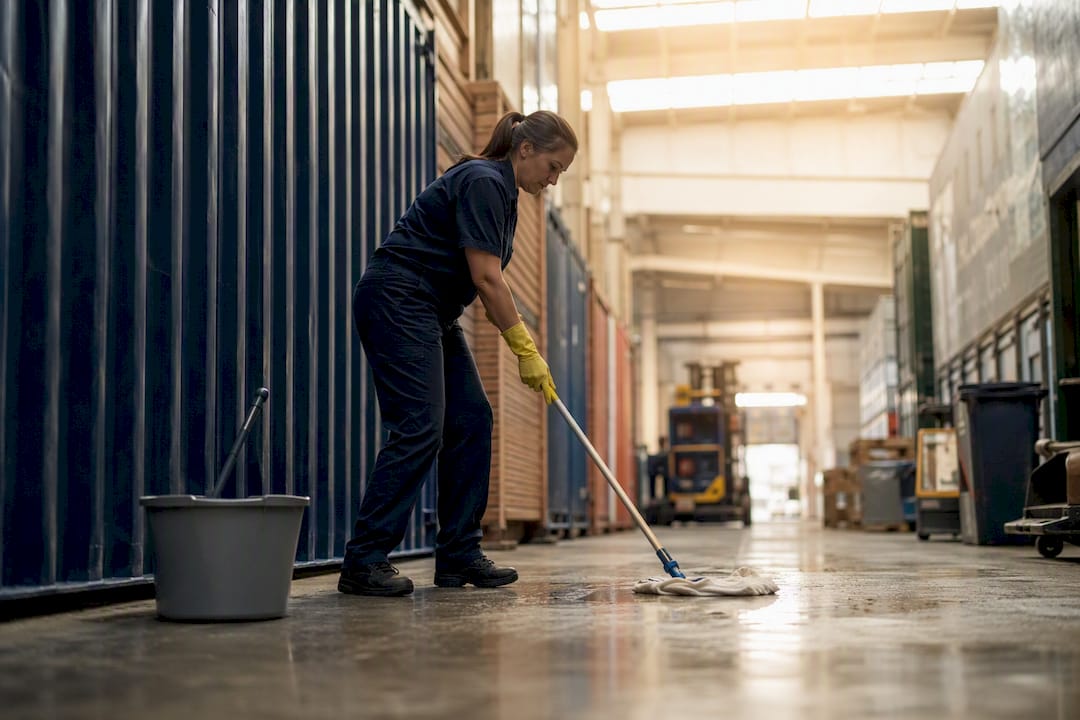
Warehouse floor being mopped with caution sign
A ready-to-use warehouse cleaning checklist runs on four cycles: daily, weekly, monthly and quarterly. Daily covers sweeping, spills and waste. Weekly adds machine scrubbing and dusting. Monthly and quarterly handle HVAC, racking and structural inspections aligned with ISO 45001 safety principles. Grab a template from SafetyCulture or build your own, but go digital where you can, timestamped and photo-backed, so sign-off actually means something.
- Daily: sweep aisles, clear trip hazards, sanitise high-touch points
- Weekly: scrub floors, dust racking, deep clean amenities
- Monthly/quarterly: HVAC checks, pallet-rack inspection, exterior pressure wash
Key Takeaways
A schedule-first checklist that assigns zone ownership and captures digital, timestamped evidence is the single most reliable way to keep a warehouse audit-ready.
| Point | Details | | --- | --- | | Use a four-tier schedule | Split tasks into daily, weekly, monthly and quarterly cycles so nothing drifts into backlog. | | Prioritise by risk, not habit | Give loading docks, food-contact racking and restrooms more frequent attention than general storage. | | Assign named zone owners | Every area needs one person accountable per shift, not a shared, ambiguous responsibility. | | Go digital for documentation | Timestamped photos and digital sign-off hold up far better in an audit than a paper checklist. | | Consider a professional partner | Shine Wise Cleaning runs checklist-driven cleans with police-checked teams across Canberra and Perth. |
Table of Contents
- Warehouse cleaning checklist: daily tasks that keep operations moving
- Weekly warehouse cleaning schedule: what to rotate through
- Monthly and quarterly maintenance: the preventative layer
- What does each warehouse zone actually need?
- Which cleaning supplies and equipment do warehouses actually need?
- How do you assign zones and audit the results?
- How Shine Wise Cleaning puts this checklist into practice
- What most warehouse checklists get wrong
- Get a checklist-driven clean without managing it yourself
- Sources
- FAQ
Warehouse cleaning checklist: daily tasks that keep operations moving
Daily tasks are the ones that stop small problems becoming shutdowns. A spill left for two hours becomes a slip claim; a blocked drain left for a week becomes a flood. Nilfisk's operational guidance is blunt about this: debris removed promptly is debris that never gets tracked into a picking aisle or jammed in a conveyor.
Pro Tip: Snap a photo with a timestamp app after each shift's sanitising round. It takes ten seconds and gives you a defensible record if a safety question ever comes up later.
Weekly warehouse cleaning schedule: what to rotate through
Weekly tasks are where most sites fall behind, mostly because nothing breaks immediately when they're skipped. That's exactly why they need a fixed slot on the calendar rather than a "when we get to it" approach.
- High priority: machine scrubbing of high-traffic aisles, loading-dock sweep and dock-plate checks
- Medium priority: dusting racking uprights and picking faces
- Medium priority: breakroom and restroom deep clean, including grout and fixtures
- Low priority: inventory storage area tidy-up and label checks
On multi-shift sites, schedule dock and aisle scrubbing between shift changes when the floor is briefly clear. Save restroom and breakroom deep cleans for after hours, when they won't collide with staff traffic.
Monthly and quarterly maintenance: the preventative layer
This is where cleaning turns into asset protection. Skip monthly HVAC filter checks and you're not just risking dusty air. You're risking a compressor working harder than it should, which shows up later as a repair bill. Cleantec's best-practice guide treats this tier as the difference between reactive cleaning and a genuine maintenance programme.
| Frequency | Task | Sign-off | | --- | --- | --- | | Monthly | High dusting (beams, light fittings, ductwork) | Shift supervisor | | Monthly | HVAC filter inspection and replacement | Facility manager | | Monthly | Pallet-rack detailed clean and structural check | Facility manager | | Quarterly | Pressure-wash exterior loading areas | Facility manager | | Quarterly | Full ventilation/HVAC service | External contractor | | Quarterly | Lighting and safety-marking audit | Site safety officer |
- Record every audit checkpoint with a date, the inspector's name and any corrective action raised.
- Flag repeat issues (same rack, same drain, same light fitting) for a root-cause review rather than another quick fix.
What does each warehouse zone actually need?
A single schedule applied evenly across a whole site misses the point. Loading docks and cold storage don't carry the same contamination risk as an office corridor, so they shouldn't get the same treatment.
Floors: daily debris removal and spill containment, with machine scrubbing on a weekly rotation. Use a degreaser on high-traffic aisles where forklift tyres and hydraulic drips accumulate; plain water and a mop won't shift compacted residue.
Cleaning tasks and frequency comparison across warehouse zones
Racking and aisles: vacuum or HEPA-wipe picking faces weekly, remove loose packaging daily, and inspect corners and floor level for pest signs. Rodents and insects follow food debris into racking gaps long before anyone notices stock damage.
HEPA vacuum cleaning warehouse racking
Loading dock: sweep daily, respond immediately to oil or vehicle fluid spills, and clean dock levellers on a weekly basis. Docks are consistently the highest-contamination zone on any warehouse floor, so schedule the detailed clean for shift-change windows when trucks aren't queued.
Clean loading dock with oil spill kit nearby
Restrooms and offices: sanitise daily and check supply levels. Breakrooms need more frequent waste removal and surface sanitising than a standard office, given food handling.
Cold storage: HEPA-filtered vacuuming rather than dry sweeping, ongoing moisture control and scheduled anti-mould inspections. Moisture that sits unaddressed here becomes mould, and mould in cold storage is a product-loss problem, not just a cleaning one.
Pro Tip: Walk each zone with a checklist app once a month and rate contamination risk from one to five. It takes twenty minutes and tells you exactly where your weekly cleaning hours are best spent.
Which cleaning supplies and equipment do warehouses actually need?
The right kit depends on the surface and the contaminant, not on whatever's cheapest at the supplier. KC Professional's checklist recommends building equipment choices around a risk audit rather than habit.
- Ride-on scrubbers for large floor areas and high-traffic aisles, ideally with higher scrub-head pressure for compacted tyre marks and hydraulic fluid.
- Walk-behind scrubbers for tighter racking aisles and dock areas.
- Industrial sweepers for daily debris clearance across open floor space.
- HEPA vacuums for cold storage, dust-sensitive zones and racking.
- Pressure washers for exterior aprons and loading bays.
- ATP swab kits, where hygiene verification matters, for food-contact or allergen-handling areas.
Run a colour-coded wipe and cloth system to stop cross-contamination: red for restrooms, blue for general surfaces, green for anywhere food-safe standards apply. Store chemicals by compatibility, never by convenience, and keep PPE (gloves, eye protection, respirators for aerosol chemicals) stocked at every cleaning station.
Pro Tip: Label chemical storage shelves by hazard class, not just by product name. It halves the time a new starter needs to find the right item safely.
How do you assign zones and audit the results?
A checklist only works if someone owns each part of it. Here's a simple way to structure that:
- Map the site into zones, floors, racking, dock, amenities, cold storage, and assign one named owner per zone per shift.
- Set frequency by risk, not habit. High-risk zones (loading dock, food-contact racking, restrooms) get daily attention; lower-risk zones like general storage can run weekly. [KC Professional's approach](https://www.kcprofessional.com/en-gb/workplace-insights/agile-manufacturing/factory-cleaning-checklist) recommends ATP testing where hygiene verification genuinely matters.
- Capture evidence digitally. Timestamped check-offs and photos beat a paper sheet pinned to a noticeboard, because [Cummins Facility Services](https://www.cumminsfs.com/warehouse-sanitation-best-practices/) points out that technology-enabled verification is what actually holds up during a regulatory inquiry.
- Log corrective actions, not just completed tasks. Note what was found, what was done, and who signed off.
Pro Tip: A compact audit template only needs five columns: zone, date, inspector, issue found, action taken. Anything more elaborate tends to get abandoned within a month.
If you're formalising this with an external cleaning contractor, a clear commercial cleaning contract checklist helps lock in scope, frequency and verification method before the first clean happens.
How Shine Wise Cleaning puts this checklist into practice
A Perth logistics client came to Shine Wise Cleaning with a recurring problem: dock-plate grime and racking dust were triggering audit flags every quarter, and paper checklists weren't catching the gaps between cleans. The fix was straightforward. Zones were mapped and assigned to named team members, dock cleaning moved to shift-change windows, and every clean was logged with timestamped photos rather than a signature on paper. The next facility audit passed without a single dock-related note.
- Zone ownership assigned per shift, not left ambiguous
- Digital, timestamped documentation replacing paper sign-off
- Periodic deep cleans scheduled around the client's own production calendar
Consistency, not intensity, is what gets a warehouse through an audit clean. A police-checked team following the same checklist every week beats an occasional heroic scrub-down.
Shine Wise Cleaning's teams are police-checked and have supported more than 500 satisfied customers across residential and commercial jobs in Canberra and Perth.
What most warehouse checklists get wrong
Most published checklists treat every zone as equally risky, which is where they fall down in practice. A loading dock and a general storage aisle do not need the same cleaning frequency, and pretending otherwise wastes labour hours on low-risk areas while high-risk zones drift.
The other gap is documentation. Plenty of managers run a genuinely solid cleaning routine and still fail an audit, because nothing proves it happened. A timestamped photo log is not bureaucratic overhead. It is the only thing standing between "we clean the dock daily" and being able to demonstrate it to an inspector or an insurer.
If there's one thing worth prioritising first, it's zone-based risk assessment over a flat schedule. Work out which areas actually carry contamination or safety risk, put your best cleaning hours there, and let lower-risk zones run on a lighter weekly rhythm. Everything else in this checklist, the supplies, the equipment, the sign-off process, works better once that foundation is in place.
Get a checklist-driven clean without managing it yourself
There's a real gap between writing a checklist and running one consistently across every shift, every week, for months on end. Shine Wise Cleaning fills that gap for warehouse and facility managers across Canberra and Perth who want the audit trail without the internal admin. Every job follows a documented checklist with supervisor sign-off, and teams are police-checked, which matters when they're moving through secure storage and loading areas unsupervised.
Shinewisecleaning
For warehouses managing office, breakroom or reception zones alongside the main floor, Shine Wise Cleaning's office cleaning and construction cleaning services cover both the everyday upkeep and the heavier post-fit-out cleans. If your loading apron or concrete forecourt needs a scheduled pressure wash rather than a one-off, get a pressure cleaning quote and set it up on the same recurring basis as the rest of your checklist.
Sources
For deeper templates, SafetyCulture's factory checklist and PopProbe's 35-item nightly checklist both support photo and timestamp evidence.
- [Industrial Factory Cleaning Checklist](https://safetyculture.com/checklists/maintenance/factory-cleaning)
- [Best practices guide to cleaning warehouses and logistics facilities](https://www.cleantec.us/best-practices-guide-cleaning-warehouse-logistics/)
- [Industrial factory cleaning checklist](https://www.kcprofessional.com/en-gb/workplace-insights/agile-manufacturing/factory-cleaning-checklist)
- [6 tips on cleaning a warehouse and sanitizing it](https://www.nilfisk.com/en-us/professional/news-and-articles/tips-on-cleaning-a-warehouse/)
- [Warehouse sanitation best practices | Cummins Facility Services](https://www.cumminsfs.com/warehouse-sanitation-best-practices/)
FAQ
What is the 20/10 rule for cleaning?
Cleaning in short bursts with focused work followed by a brief reset works well for daily warehouse tasks like aisle sweeping between operational windows.
What is a standard cleaning checklist?
A standard checklist separates tasks by frequency, daily, weekly, monthly and quarterly, and assigns each item an owner, a time estimate and a sign-off requirement, as outlined throughout this warehouse cleaning checklist.
What are the 7 steps of cleaning?
Most industrial cleaning procedures follow a sequence: pre-clean and remove debris, apply cleaning agent, agitate or scrub, rinse, sanitise, allow to dry, then inspect and sign off, a structure reflected in KC Professional's audit checklist.
What is the 6 to 10 cleaning list?
Definitions of this list vary by industry and aren't consistently documented for warehouse settings, so it's best to build your own risk-based list of six to ten priority tasks specific to your site's highest-contamination zones.
Should a warehouse go paperless with its cleaning checklist?
Yes. Digital, timestamped checklists with photo evidence are far more defensible during an audit than paper sign-off sheets, and providers like Shine Wise Cleaning build this documentation into every scheduled clean.
Recommended
- [After Hours Office Cleaning Perth: A Practical | Shine Wise](https://shinewisecleaning.com.au/blog/after-hours-office-cleaning-perth)
- [Office Cleaning Canberra: Complete | Shine Wise](https://shinewisecleaning.com.au/blog/office-cleaning-canberra-complete-room-by-room-checklist)
- [Pre Sale Deep Cleaning Perth: A Room Priority | Shine Wise](https://shinewisecleaning.com.au/blog/pre-sale-deep-cleaning-perth)
- [How to Prepare for Professional House Cleaning | Shine Wise](https://shinewisecleaning.com.au/blog/how-to-prepare-for-professional-house-cleaning-perth)
Related services
Ready to book your clean?
Free quote · No obligation · Canberra & Perth
Related articles
Deep Cleaning Perth: Protect Your Bond and Your Home
A proper deep clean in Perth can mean the difference between getting your full bond back or losing hundreds of dollars.
Read articleThe complete deep cleaning checklist: room by room
Transform your home with our room-by-room deep cleaning checklist. Tackle grime effectively and enjoy a refreshed living space today!
Read article