Office cleaning checklist: daily, weekly and monthly template
Published: 21 August 2026 · By Shine Wise Cleaning Team, Founder of Shine Wise Cleaning · Updated: 21 August 2026
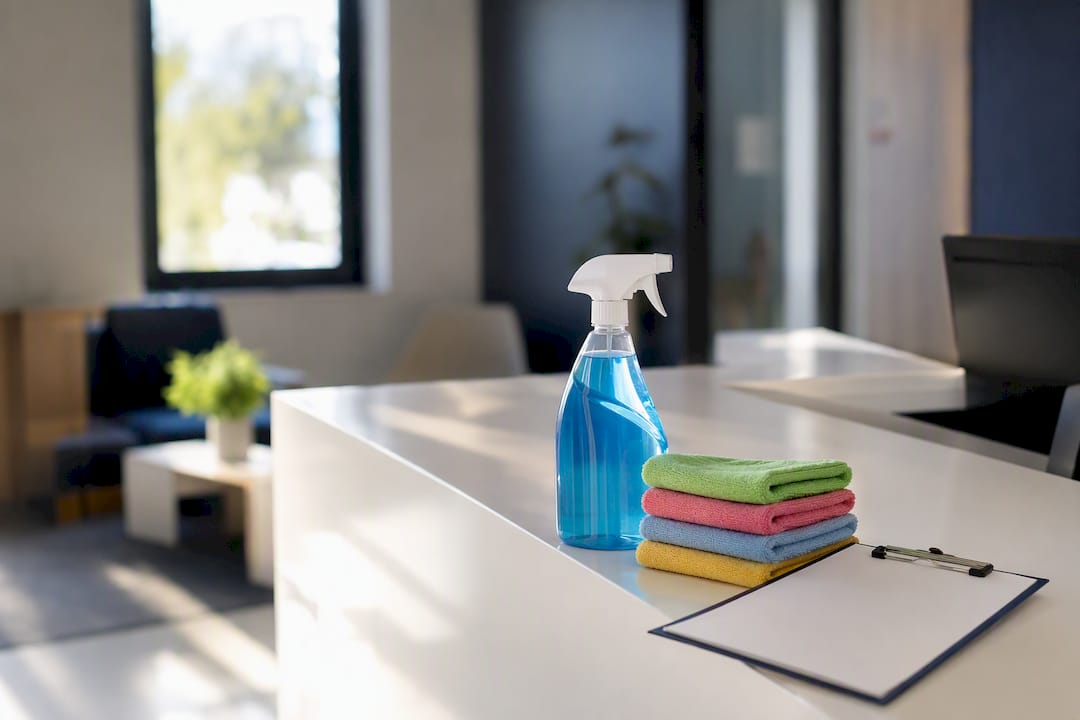
Office cleaning supplies and checklist on counter
Use a zone-based checklist split into daily, weekly, and monthly tasks, with an owner and a record method against each entry, and you solve most of what makes offices look neglected. Daily cleaning of high-touch surfaces cuts germ presence by roughly 80% in busy areas like restrooms and kitchens, and structured cleaning programs have been linked to a noticeable drop in sick days at some facilities. Copy the schema in the template section below straight into Excel or Google Sheets, or hand it to your cleaning contractor as a scope of work.
Key Takeaways
A zone-based checklist with an owner, a completion standard and a record method against each task is what separates a working cleaning schedule from a list nobody follows.
| Point | Details | | --- | --- | | Daily tasks protect health | Disinfecting high-touch points daily can cut germ presence by roughly 80% in busy zones like restrooms and kitchens. | | Frequency follows consequence | Set cadence by asking what happens if a task is missed once versus missed for a week. | | Build the master list first | List every cleanable item by zone before assigning frequency to avoid gaps. | | Six fields make it a control | Every entry needs zone, task, frequency, owner, expected result and record method to function as proof, not just a plan. | | Audit regularly, not occasionally | Track pass rate, re-clean rate and complaint volume to catch problems before they become patterns. |
Table of Contents
- Office cleaning checklist at a glance
- What daily office cleaning tasks should you never skip?
- What weekly tasks keep an office from slowly degrading?
- Which cleaning tasks belong on a monthly or seasonal schedule?
- How do you build an office cleaning schedule that actually holds up?
- How do you audit a cleaning schedule and prove the work happened?
- A copyable checklist you can paste into a spreadsheet
- Why most office cleaning checklists fail within a month
- Ready to hand this checklist to someone else?
- Sources
- FAQ
Office cleaning checklist at a glance
Print this, stick it to the supply cupboard, and hand a copy to whoever runs the mop.
Daily
- Empty and reline bins in every zone, including under-desk bins in the open office.
- Disinfect door handles, light switches, lift buttons and shared phones.
- Wipe down reception desk, meeting room tables and break room benches.
- Clean and restock restrooms: toilets, basins, soap, paper towel, toilet paper.
- Vacuum or spot-mop high-traffic walkways and entry mats.
- Wipe printer buttons and shared copy room surfaces.
Weekly
- Detail-dust shelving, blinds and skirting boards.
- Empty and wipe out the break room fridge.
- Vacuum edges, corners and under furniture that daily runs skip.
- Refill soap and sanitiser dispensers and check stock levels.
- Spot-clean interior glass partitions and meeting room walls.
Monthly
- Check and replace HVAC filters where accessible.
- High-dust ceiling vents, light fittings and the tops of cabinets.
- Spot-extract carpet stains in walkways and under desks.
- Wash out bin liners and bin bodies, not just the liner swap.
Pro Tip: Add a small initials-and-date box next to each monthly task on the printed sheet. It costs nothing and it's the fastest way to prove a job was actually done when someone asks "did anyone check the filters this month?"
What daily office cleaning tasks should you never skip?
Daily tasks are the ones that protect health, not just appearance, so they need a fixed, non-negotiable list rather than "clean as needed."
Reception and lobby: empty bins, wipe the front desk, dust visible surfaces, spot-clean glass doors and mats.
Workstations and open office: empty bins, wipe shared surfaces (not personal desks unless contracted), disinfect keyboards on shared hot-desks, vacuum main walkways.
Meeting rooms: wipe tables, clean whiteboards, disinfect remote controls and shared AV equipment, reset chairs.
Break room / kitchenette: wipe benches, clean sink, empty bins, disinfect microwave handles and fridge door handles.
Restrooms: clean and disinfect all fixtures, restock consumables, mop floors, check for leaks.
Copy/support rooms: wipe machine exteriors and shared touchpoints, empty recycling.
Door handles, light switches, shared remotes and printer buttons carry more bacteria than most people expect because dozens of hands touch them daily. Colour-coded microfibre cloths for restrooms versus food areas stop cross-contamination, and any cleaner handling chemicals should have gloves and easy access to Safety Data Sheets.
Cleaning professional wiping office door handle
What weekly tasks keep an office from slowly degrading?
Daily tasks handle hygiene. Weekly tasks stop the slow creep of grime that daily quick-wipes miss.
- Detailed dusting of shelves, picture frames, vents and blinds.
- Full fridge clean-out, including expired-food checks in the break room.
- Edge and corner vacuuming, under furniture, behind doors.
- Polish and refill dispensers, check soap and sanitiser stock against usage.
- Spot-clean interior glass and partition walls.
Schedule weekly work for the lowest-occupancy window, typically Friday afternoon or first thing Monday, so vacuums and mop buckets aren't weaving around desks. Pro Tip: Batch every dusting task into one pass through the floor instead of one room at a time. It halves the time a cleaner spends walking between zones.
Which cleaning tasks belong on a monthly or seasonal schedule?
Monthly and periodic tasks are where preventive maintenance lives, protecting the building's assets rather than just its appearance.
- Check and replace HVAC filters to protect air quality and equipment life.
- High-dust ceilings, vents and light fittings that daily and weekly runs never reach.
- Spot-extract carpet stains before they set permanently.
- Wash out bin bodies, not just swap liners.
Quarterly and seasonal work adds hard-floor recoating, full upholstery extraction and exterior window cleaning, all of which should be triggered by foot traffic, season or upcoming events rather than a fixed date. A busy retail-facing office might need exterior glass cleaning every quarter; a quiet back office might stretch that to twice a year. After a fit-out or renovation, a one-off construction clean resets the baseline before the periodic schedule resumes.
How do you build an office cleaning schedule that actually holds up?
Start with a walk-through, not a spreadsheet. Map every zone in the building, including the ones nobody thinks about (server rooms, stairwells, storage cupboards), because gaps in the master task list are where disputes and missed spots come from later.
- Walk the floor and list every zone and cleanable surface.
- Build a master task library covering every item you found.
- Assign frequency by consequence: what breaks if this is missed once versus missed for a week?
- Assign an owner to each task, whether that's in-house staff or a [contracted cleaner](https://shinewisecleaning.com.au/services/office-cleaning-perth).
- Pilot the schedule for two weeks and adjust anything that's unrealistic.
- Roll it out and start auditing against it.
A restroom missed for one day causes complaints; a fridge missed for a week causes an odour problem; an HVAC filter missed for a month barely registers. That's the logic that should decide your cadence, not habit.
Every checklist entry needs these fields to function as a real control rather than a wish list: zone, task, frequency, owner, estimated time, expected result (the completion standard, e.g.
A daily restroom entry might read: Restrooms, disinfect fixtures, daily, cleaning contractor, 15 minutes, no odour or visible residue, initialled sign-off sheet. A weekly fridge reset: Break room, empty and wipe fridge, weekly, office manager, 10 minutes, no expired items, checkbox on shared roster. A monthly HVAC check: Mechanical room, inspect/replace filter, monthly, facilities contractor, 20 minutes, filter clean or replaced, work order ID in CMMS.
How do you audit a cleaning schedule and prove the work happened?
An audit doesn't need to be complicated: a quick visual pass, a photo of any exception, a par-level check on supplies, and the occasional random spot check on a task someone signed off.
- Walk each zone against the checklist and mark pass/fail.
- Photograph anything that fails so there's a record, not just an opinion.
- Check supply stock (soap, paper towel, bin liners) against expected usage.
- Randomly re-check a "completed" task once a fortnight to keep sign-offs honest.
Track a few numbers over time: inspection pass rate, re-clean rate, complaint volume, and how fast issues get resolved once flagged. Verification can be as simple as a paper sign-off sheet or as structured as a CMMS closeout with a timestamp, but either way, a zone-based schedule with owner and record fields is what turns "I think it got done" into "here's proof it got done."
A copyable checklist you can paste into a spreadsheet
Copy these columns into Excel or Google Sheets, or import them into a CMMS if you're running multiple sites or shifts: Zone, Area/room, Task, Frequency, Owner/role, Estimated time, Expected result, Method/product note, Record method, Notes/escalation, Inspection checkbox, Last completed.
| Zone | Task | Frequency | Owner | Record method | | --- | --- | --- | --- | --- | | Reception | Wipe desk, dust surfaces, spot-clean glass | Daily | Contract cleaner | Initials on sheet | | Restrooms | Disinfect fixtures, restock consumables | Daily | Contract cleaner | Timestamp/CMMS | | Meeting rooms | Wipe table, clean whiteboard, disinfect remote | Weekly | Office staff/cleaner | Checkbox on roster |
Office cleaning checklist zones and frequencies diagram
Add a filter by frequency so staff only see today's list, keep a print-friendly version for noticeboards, and switch on mobile checkboxes once you need timestamps across multiple shifts. Printable Word or Canva templates work fine for a single site; once you're running more than one location or shift, a CMMS earns its keep through the audit trail alone. If cleaners work outside business hours, note access codes, restricted areas and client privacy rules directly on the sheet, the same way an after-hours cleaning arrangement would.
Why most office cleaning checklists fail within a month
Most checklists don't fail because they're wrong. They fail because nobody owns them. A generic list gets pinned up, everyone assumes someone else is checking it, and within three weeks half the monthly tasks haven't happened and nobody noticed.
The fix isn't a longer list. It's fewer, better-defined tasks with a name attached to each one and a completion standard specific enough that "clean" isn't a matter of opinion. "Wipe the fridge" is vague. "No visible spills, no expired items, wiped shelves" is a standard a cleaner can actually meet or fail.
We'd also push back on the idea that daily tasks matter more than monthly ones. HVAC filters and carpet extraction don't show up in a walkthrough, but they're the tasks that protect the building's air quality and asset value over years, not days. Skip daily bin runs and you'll hear about it by lunchtime. Skip filter changes for six months and you won't notice until the air quality complaints start or the carpet needs early replacement.
Start with the fields, not the frequency. Get owner, standard and record method right, and the schedule enforces itself.
Ready to hand this checklist to someone else?
Building the schedule is the easy part. Running it week after week, chasing sign-offs, covering sick days, sourcing the right chemicals for a hundred different surfaces, is where most in-house systems quietly fall apart. Shinewisecleaning runs contracted office cleaning across Canberra ACT and Perth WA with police-checked teams, flexible after-hours scheduling, and a checklist-driven scope of work that matches exactly what's laid out above. If you're in Canberra, the local office cleaning service covers the same zone-based approach with eco-friendly product options and clear reporting, so you get proof of completion, not just a promise.
Sources
FAQ
What is included in office cleaning?
A standard office clean covers bin removal, disinfecting high-touch surfaces, restroom sanitation, floor care, break room cleaning, and restocking consumables like soap and paper towel, with deeper tasks like HVAC checks and carpet extraction handled monthly or quarterly.
How often should an office be cleaned?
High-touch zones like restrooms, kitchens and shared surfaces need daily attention; detail work like fridge resets and edge vacuuming suits a weekly cycle, and preventive tasks like filter changes and carpet extraction work well monthly.
How often should office bathrooms be cleaned?
Office restrooms should be cleaned and disinfected daily at minimum, with high-traffic buildings often needing a midday touch-up on top of the morning clean.
How do I create an office cleaning checklist?
Walk the floor to map every zone, build a master task list, assign frequency by consequence, then give each task an owner, an expected result and a record method before rolling the schedule out and auditing it.
What is the daily cleaning routine for an office?
A daily routine typically covers emptying bins, disinfecting door handles and shared equipment, wiping desks and meeting tables, cleaning restrooms, and vacuuming or mopping main walkways before staff arrive the next day.
Recommended
- [Office Cleaning Canberra: Complete | Shine Wise](https://shinewisecleaning.com.au/blog/office-cleaning-canberra-complete-room-by-room-checklist)
- [After Hours Office Cleaning Perth: A Practical | Shine Wise](https://shinewisecleaning.com.au/blog/after-hours-office-cleaning-perth)
- [Regular Home Cleaning Perth | House Cleaners](https://shinewisecleaning.com.au/services/house-cleaning-perth)
- [Office Cleaning Canberra: What to Expect | Shine Wise](https://shinewisecleaning.com.au/blog/office-cleaning-canberra-what-to-expect-avoid-save)
Related services
Ready to book your clean?
Free quote · No obligation · Canberra & Perth
Related articles
Office Cleaning Canberra: Complete Room-by-Room Checklist
Master your workplace hygiene with this comprehensive office cleaning checklist tailored for Canberra businesses.
Read articleA practical warehouse cleaning checklist for busy managers
Streamline your operations with a practical warehouse cleaning checklist. Ensure safety and efficiency through daily, weekly, and monthly tasks.
Read article