Pressure washing safety: what a professional should guarantee
Published: 26 August 2026 · By Shine Wise Cleaning Team, Founder of Shine Wise Cleaning · Updated: 26 August 2026
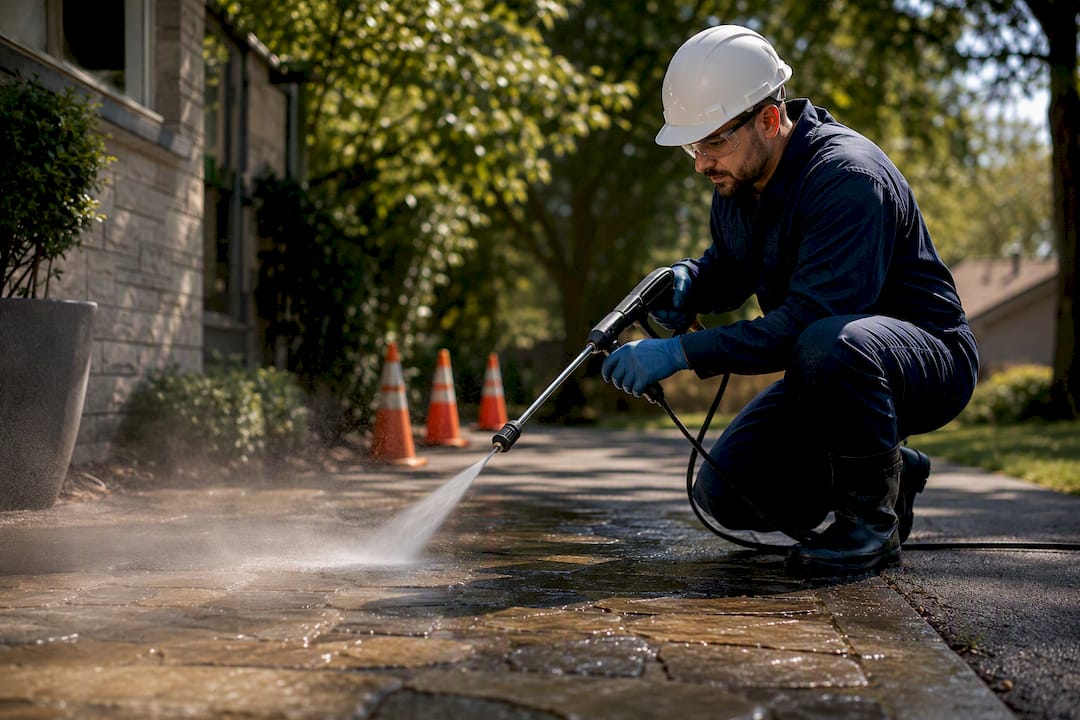
Technician adjusting pressure washer hose on driveway
A safe professional pressure-washing job means a documented site walkthrough, verified insurance, the right method for the surface, electrical safeguards, and a post-job walkthrough before anyone calls the job finished. If a provider can't show you these five things, keep looking.
Pressure washing safety, in the context of hiring a company, has almost nothing to do with the operator's own gear. It's about what the business does to protect your property, your family, and itself from liability. Before booking anyone, insist on:
- A Certificate of Insurance (COI) covering general liability, emailed directly from the insurer
- Active workers' compensation cover for every technician on site
- A site-specific safety walkthrough before any water touches your property
- Correct method selection, soft-wash for render, timber and painted surfaces, high pressure only where the substrate can take it
- A wastewater and runoff plan that keeps detergent out of garden beds and stormwater drains
A Certificate of Insurance verified by the provider's own insurer is the single strongest proof you can request, and it costs you nothing to ask for it. Shine Wise Cleaning builds every pressure-cleaning job around these exact checks, which is the standard the rest of this guide holds every provider to.
Key Takeaways
Safe professional pressure washing depends on verified insurance, a site-specific walkthrough, correct method selection, and a documented post-job inspection, not on the operator's own equipment alone.
| Point | Details |
|---|---|
| Verify insurance directly | Ask the insurer to email a Certificate of Insurance covering liability and workers' compensation. |
| Match method to surface | Soft-wash suits render, timber and paint; high pressure suits concrete and brick only. |
| Confirm electrical safety | Every outlet used should pass a GFCI test before the machine starts. |
| Prepare your property | Close windows, secure pets and furniture, and note fragile features in writing beforehand. |
| Choose a documented provider | Shine Wise Cleaning runs police-checked crews and a checklist-based process across every pressure-cleaning job in Canberra and Perth. |
Table of Contents
- What does pressure washing safety actually look like on site?
- What should you ask before you agree to a booking?
- What should you do to prepare your property?
- What risks worry homeowners most, and how do professionals manage them?
- What does a real job look like from start to finish?
- Does the crew need formal training or certification?
- What happens if something goes wrong on the job?
- How do professionals handle ladders and height work safely?
- What protective gear should the crew be wearing?
- How is the equipment itself operated safely?
- Why hiring a pro beats DIY on anything but the basics
- Book pressure cleaning with the safety checks already built in
- Sources
- FAQ
What does pressure washing safety actually look like on site?
A reputable crew treats the ten minutes before they turn a machine on as more important than the wash itself. Here's the sequence you should see, in order.
- Documentation check. The crew leader confirms the COI, workers' compensation, and any required licences before equipment leaves the van.
- Police-checked crew confirmation. Staff working around your home or business have been vetted, not just hired.
- Site walkthrough. The technician walks the perimeter with you, flagging loose render, ageing sealant, timber decking, or garden beds that need protecting.
- Electrical safety pass. Every outlet used gets a GFCI (safety switch) test, and cords are run clear of pooling water.
- Method selection. Soft-wash for painted cladding, timber, and delicate render; high pressure reserved for concrete, brick, and hard pavers. This mirrors the pressure and method matching that prevents surface damage that trade guides consistently recommend.
- Chemical selection and containment. Biodegradable detergents go down first, with drains and garden beds protected from runoff.
- Crew briefing and signage. Everyone on the job knows the perimeter, the hazards, and where hoses will run.
- Photographic documentation. Before shots establish existing wear, damage, or staining.
- The wash itself, working from top to bottom, low pressure to high, with test patches on new surfaces.
- Post-job walkthrough. You and the technician inspect the result together, with a written checklist as the record.
Pro Tip: Ask the crew to test a hidden patch of render or timber first, low pressure, before they run the full job. It costs thirty seconds and it's the cheapest insurance against a $2,000 repaint.
Any step missing from that list is worth asking about before the machine starts.
What should you ask before you agree to a booking?
A five-minute phone call before booking saves you from disputes later. Ask these questions and expect a straight answer to every one.
- "Can you email me your Certificate of Insurance?" A provider who hesitates or offers only verbal assurance is a red flag, since written proof of liability and workers' compensation cover is standard practice, not a special request.
- "Are your staff police-checked?" This matters more for jobs where crews access secured areas, courtyards, or occupied premises.
- "Which method will you use on my render/deck/driveway, and why?" A competent technician explains the choice in plain language, not jargon.
- "Where does the wastewater go?" Detergent and grime shouldn't end up in your garden beds or the stormwater system.
- "Will I get a written checklist and a walkthrough at the end?" This is your record if anything needs raising afterwards.
A provider who can also supply before/after photos and references from past jobs gives you more confidence than one relying on a quote alone.
What should you do to prepare your property?
Preparation is a two-way street. Safety is genuinely a shared responsibility: the provider gives clear instructions, and following them cuts risk for everyone involved. Here's what a competent company will ask of you before the crew arrives.
- Close and lock every window and vent. Even light spray under pressure can push moisture past seals that hold up fine in rain.
- Move or cover furniture, toys, vehicles, and delicate plants. Anything that can shift or stain should be clear of the work zone.
- Keep kids and pets indoors. Agree on a perimeter with the crew so nobody wanders into the spray path.
- Confirm power and water access. A GFCI-protected outlet needs to be available, or the provider should bring a generator.
- Lock in timing and access arrangements. If you won't be home, note any fragile features (old paint, loose flyscreens, cracked render) in writing beforehand.
If you've never had a professional clean before, our guide on preparing for a professional house clean covers similar groundwork that applies just as well here.
What risks worry homeowners most, and how do professionals manage them?
Every homeowner has the same short list of fears. Here's what a competent crew does about each one.
- Surface damage. Mitigated through pressure profiling (starting low and testing before ramping up), correct nozzle selection, and soft-wash chemistry on anything that isn't bare concrete or brick.
- Hidden water intrusion. Bad spray angles or excessive pressure can push moisture behind cladding, leading to mould growth you won't see for weeks. Correct angles and test patches prevent it.
- Electrical shock. Managed with GFCI testing on every circuit used, connections kept clear of standing water, and cords elevated where possible, in line with CDC guidance on pressure-washer electrical hazards.
- Chemical damage to plants or waterways. Addressed with biodegradable detergents and a containment plan that keeps runoff out of garden beds and drains.
- Personal injury and trip hazards. Reduced through clear signage, disciplined cord and hose management, and a defined perimeter that keeps bystanders out of the spray zone.
High-pressure spray can cause serious puncture wounds and throw debris at close range, which is exactly why perimeter control isn't a courtesy. It's a hard requirement.
What does a real job look like from start to finish?
Here's how a checklist-driven job typically runs, using the process Shine Wise Cleaning follows on residential and commercial sites.
- Pre-arrival confirmation. The client gets a time window and a reminder of what to prepare (windows shut, pets inside, access clear).
- On-site setup. The crew walks the perimeter, tests the GFCI outlet, confirms method choice against the surfaces present, and briefs everyone on hazard zones.
- Documentation as they go. Before photos, method notes, and any pre-existing damage get recorded before water touches the surface.
- The wash. Soft-wash or high pressure, matched to substrate, working methodically rather than rushing corners.
- Post-service walkthrough. The client and technician inspect the result together against a written checklist.
A written checklist and a joint walkthrough turn a subjective "looks clean to me" into a documented record both parties can point back to if a question comes up later.
Shine Wise Cleaning's crews are police-checked, the business has completed more than 500 residential and commercial jobs, and every one follows the same checklist regardless of whether it's a driveway or a commercial forecourt. Eco-friendly detergent options are available for clients who want them.
Does the crew need formal training or certification?
There's no single national licence required to operate a pressure washer in Australia, but that doesn't mean training is optional. Reputable companies run their own induction covering equipment handling, chemical safety data sheets, and electrical checks before a new technician works unsupervised.
Look for evidence of structured onboarding rather than a certificate on a wall. That means a probationary period working alongside an experienced technician, documented sign-off on safety procedures like GFCI testing and chemical handling, and refresher training when new equipment or detergents are introduced. Workers' compensation cover itself is a decent proxy for training standards, since insurers generally expect an employer to demonstrate safe systems of work before they'll underwrite a policy at a reasonable premium.
For jobs involving working at height, confined access, or industrial-strength chemicals, ask specifically whether the technician assigned has done that type of job before. A crew that's spent years on driveways and patios isn't automatically ready for a three-storey render job, and a good company will tell you that honestly rather than send whoever's available.
Does the crew need formal training or certification?, overview diagram
What happens if something goes wrong on the job?
Even a well-run job can hit a snag: a chemical splash, a slip on wet pavement, or a spray injury from a kinked hose suddenly releasing pressure. What separates a professional outfit from a risky one is what happens in the next five minutes.
A competent crew carries a basic first-aid kit on every job and knows the nearest medical facility to the site. For anything beyond a minor scrape, the standard response is straightforward: stop work immediately, flush chemical exposure with clean water, and treat puncture-type injuries from high-pressure spray as a medical emergency rather than a first-aid matter, since these injuries can look minor on the surface while causing deep tissue damage.
Ask your provider, before booking, whether their team has a documented incident procedure. It should cover who calls emergency services, who notifies you as the client, and how the incident gets recorded for the insurer. A company that shrugs off this question or claims "it's never happened" isn't reassuring, it's a gap. Incidents happen in every trade; what matters is whether the response is planned or improvised.
How do professionals handle ladders and height work safely?
Two-storey homes and commercial buildings mean a portion of pressure-cleaning jobs involve height, and this is where risk climbs sharply. A fall from even a single-storey roofline can cause serious injury, so the mitigations here matter as much as anything on the ground.
Reputable crews avoid freehand ladder work with a pressure hose wherever possible, since the recoil and weight of the hose make balance genuinely difficult. Extension wands and telescopic lances let technicians clean upper storeys from the ground or from a stable platform, cutting the need to climb at all for many jobs. Where height access is unavoidable, expect to see proper ladder angles, a second crew member stabilising or spotting, and secured footing, never a ladder balanced on uneven paving or gravel.
Roof work carries its own rules again: harnesses, anchor points, and a refusal to work in wet or windy conditions. If a technician turns up and tells you the job's being rescheduled because of weather, that's not an inconvenience, it's the safety judgement you're paying for.
What protective gear should the crew be wearing?
You won't be wearing PPE as the client, but what the crew has on tells you a lot about how seriously the company takes the job. Look for closed, non-slip boots (wet pavers and tiles get slippery fast), safety glasses or a face shield to guard against chemical splash and flying debris, and puncture-resistant gloves rated for the chemicals being used, not garden gloves.
Close-up of protective gear on pressure washing technician
Hearing protection matters more than most homeowners expect. Commercial-grade pressure washers run loud enough over a full shift that sustained exposure carries real risk, and crews doing back-to-back jobs should have earplugs or earmuffs on hand. Long sleeves and, where chemicals are stronger than a standard detergent, coveralls round out a properly equipped technician.
None of this is about looking professional for its own sake. A crew in thongs and shorts on a wet driveway is a crew one slip away from an injury that delays your job and, frankly, should worry you about how they handle the rest of the work too.
How is the equipment itself operated safely?
Pressure settings and nozzle choice do most of the safety work before the trigger's even pulled. Machines used for professional jobs typically run higher pressure than a homeowner's electric unit, which makes correct setup non-negotiable rather than a nice-to-have.
Nozzles are colour-coded by spray angle, from a narrow, aggressive zero-degree tip through to a wide 40-degree fan suited to general rinsing. A trained technician starts with the widest appropriate angle and narrows it only if the surface demands more force, the reverse of what an inexperienced operator often does. This is the same pressure-profiling logic that protects render and timber: start low, test, then adjust.
Hose management matters just as much as the nozzle. Kinks can cause sudden pressure spikes when they release, and hoses left across walkways or stairs create a trip hazard for the crew and anyone else on site. Expect hoses run along edges, away from foot traffic, and coiled properly during breaks rather than left in a tangle. Machines get a visual check for wear and leaks before every job, since a failing seal under pressure is one of the more common causes of on-site injury.
Why hiring a pro beats DIY on anything but the basics
DIY pressure washing is fine for a small paved patch at ground level. It stops being a good idea the moment height, fragile render, timber cladding, or electrical proximity enter the picture. That's where certificates, police-checked crews, and a written checklist stop being paperwork and start being the thing standing between you and a $3,000 repair bill or a workers' compensation claim landing on your doorstep. Shine Wise Cleaning's checklist approach exists precisely to take that risk off a tenant's or homeowner's shoulders.
- Shine Wise Cleaning Team
Book pressure cleaning with the safety checks already built in
Shine Wise Cleaning is the option for readers in Canberra and Perth who want everything in this guide handled without having to chase a provider for proof. Every pressure-cleaning job comes with police-checked staff, current insurance, and a checklist-driven process from the site walkthrough to the final sign-off, so you're not left guessing whether the crew on your driveway is properly covered.
Shinewisecleaning
Getting proof is simple: ask for your Certificate of Insurance by email before the job is booked, and request a pre-job assessment so the crew can flag any fragile surfaces (old render, timber decking, garden beds) in writing ahead of time. Eco-friendly detergent options are available if you'd rather avoid standard chemical treatments near plants or pets. Head to the pressure cleaning services page to check availability and get a quote for your driveway, path, or patio.
Sources
- Pressure washer safety and injury guidance, CDC
- How to pressure-wash a house, Popular Mechanics
- What types of insurance should every construction company have in Australia, CBI
FAQ
Is pressure washing safe for homeowners to hire out?
Yes, when the provider verifies insurance, runs a site walkthrough, and matches method to surface; the risk sits in skipped steps, not the service itself.
What proof of insurance should I ask for?
Request an emailed Certificate of Insurance covering general liability and workers' compensation, sent directly from the insurer.
Can pressure washing damage windows or render?
Yes, if the wrong pressure or angle is used; professionals use soft-wash methods and test patches on render, timber, and glazing to prevent this.
What should I do with pets and children during the job?
Keep them indoors and agree on a clear perimeter with the crew before work starts, since spray zones and hose lines create tripping and splash hazards.
Does Shine Wise Cleaning offer eco-friendly options?
Yes, biodegradable detergent options are available on request as part of Shine Wise Cleaning's standard pressure-cleaning process in Canberra and Perth.
Recommended
Related services
Ready to book your clean?
Free quote · No obligation · Canberra & Perth
Related articles
Pressure washing vs soft washing: which one to use, and when
Discover when to use pressure washing or soft washing for optimal cleaning. Learn the right method for every surface and avoid costly mistakes.
Read articleHigh rise window cleaning safety: what facility managers must insist on
Ensure high rise window cleaning safety by demanding a detailed safety plan and certified operators before any work begins. Protect your assets.
Read article