Stop Overusing Disinfectants: Clean First, Disinfect Only After Illness
Published: 3 September 2026 · By Shine Wise Cleaning Team, Founder of Shine Wise Cleaning · Updated: 3 September 2026
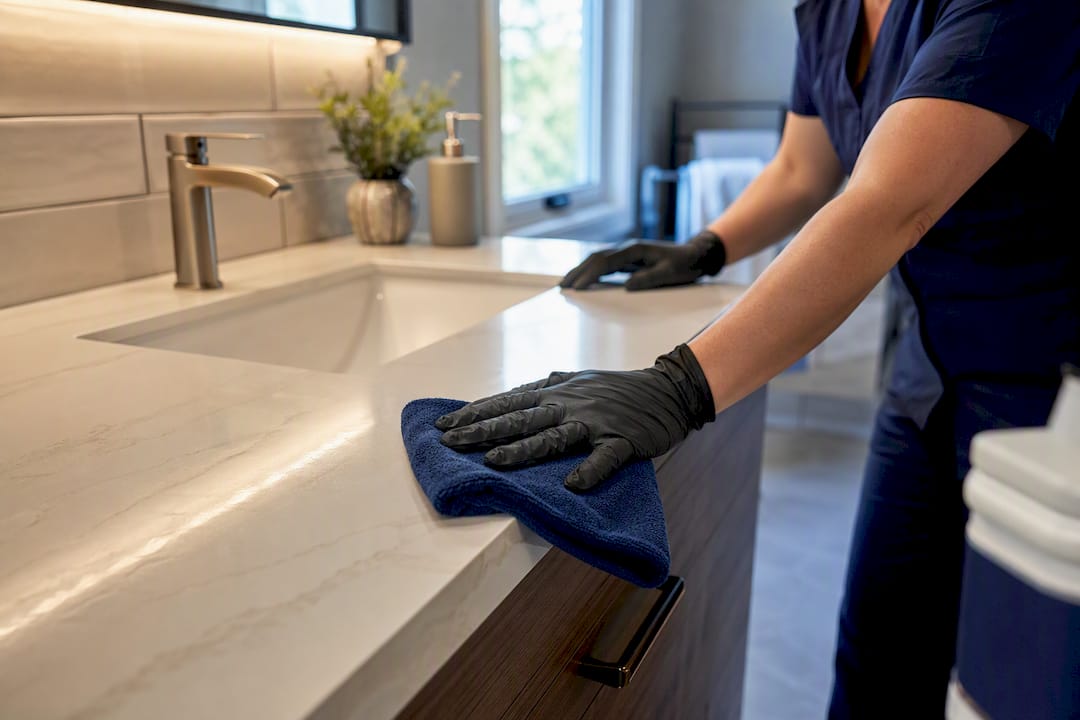
Cleaner wiping bathroom vanity before disinfecting
Clean first, always. Disinfect only when someone in the house is sick, a surface poses a real infection risk, or a bathroom needs it after illness. Sanitise where food touches surfaces, because that's what health codes require. Whatever product you pick, follow the label's contact time exactly, or you're just wiping germs around, not removing them.
***
TL;DR: - Disinfectants must be applied only after surfaces are thoroughly cleaned to ensure they can effectively reach and kill pathogens. - Using unregistered or expired disinfectants reduces effectiveness and may produce harmful fumes, emphasizing the importance of correct product selection and timing. - Sanitising is appropriate for food-contact surfaces to reduce germs to safe levels, but it does not sterilise or eliminate all microbes. - Overusing disinfectants in low-risk situations adds unnecessary chemical exposure and environmental harm, so risk-based decision-making is crucial. - Professional cleaning services follow strict protocols, including cleaning before disinfecting, to ensure maximum germ removal and safety.
***
Table of Contents
- Cleaning vs disinfecting vs sanitising: the actual difference
- When to clean, when to sanitise, when to disinfect
- How to disinfect correctly, step by step
- Sanitising in kitchens and food-prep areas
- Safety and environmental cautions worth knowing
- A practical checklist you can use today
- What professional cleaners actually do differently
- Why the "just spray something" habit needs to die
- Book a professional sanitising and disinfecting clean
- Sources
- FAQ
Cleaning vs disinfecting vs sanitising: the actual difference
Most people use these three words as if they mean the same thing. They don't, and mixing them up is why so many kitchens get a spray-and-wipe that looks clean but isn't food-safe, or a sick room that gets "cleaned" with nothing that actually kills the virus.
Cleaning is physical removal. Soap, detergent, water and some elbow grease lift dirt, grease and germs off a surface and rinse them away. It doesn't kill much of anything. It just gets rid of it.
Sanitising knocks germ numbers down to a level public health standards consider safe, most often in food-preparation areas. It's not trying to wipe out every microbe, just enough of them that food handling stays safe.
Disinfecting is the heavy-duty step: a chemical process built to kill or inactivate viruses, bacteria and fungi on surfaces. Because it's making a stronger claim, disinfectant products face a tougher registration and testing bar than sanitisers or general cleaners, and it's reserved for higher-risk scenarios rather than everyday wipe-downs.
- Cleaning: removes soil and germs physically, doesn't kill microbes
- Sanitising: reduces germs to a safe level, mainly for food-contact surfaces
- Disinfecting: kills or inactivates pathogens, used when risk is elevated
When to clean, when to sanitise, when to disinfect
Most surfaces in a home need cleaning, not disinfecting. Save the stronger stuff for when it actually earns its place.
- Daily cleaning covers benchtops, floors and general surfaces. A wipe with detergent handles the job for anything without a specific infection risk attached to it.
- High-touch surfaces (door handles, light switches, remote controls, tap handles) get a clean every day or two in a normal household, more often if someone's unwell or you've got visitors coming through constantly.
- Sanitising applies to food-prep surfaces, chopping boards and anything touching food directly, particularly where local food-safety rules make it a requirement, not an option.
- Disinfecting comes out after illness, following a vomiting or diarrhoea event, or in a household with someone immunocompromised. In most situations cleaning alone removes the bulk of germs; disinfecting is the extra step for when the stakes are higher.
- Frequency scales with risk: daily wipe for touch points, sanitise every prep session in the kitchen, disinfect only around specific events, not as a standing daily habit.
How to disinfect correctly, step by step
Skipping the clean-first step is the single biggest reason disinfecting fails. Grease, food residue and general grime physically block disinfectant from reaching the microbes underneath, so a surface that looks disinfected might not be. Health authorities are blunt about this: organic matter left on a surface interferes with disinfectant action, full stop.
Here's the sequence that actually works:
- Clean first. Wipe away visible soil with detergent and water before any chemical goes near the surface.
- Pick a registered product. Check the label for an active ingredient (like sodium hypochlorite, quaternary ammonium compounds, or hydrogen peroxide) and a registration or approval mark relevant to your region, such as TGA or APVMA in Australia, or EPA registration in the US.
- Dilute exactly as instructed. Stronger isn't better; it's often less effective and more hazardous.
- Respect the contact time. This is the number of minutes the surface needs to stay visibly wet for the disinfectant to work. Wipe it off early and you've wasted the product.
- Ventilate and glove up. Open windows, wear gloves, and avoid breathing in fumes from concentrated products.
- Let it dry or rinse per the label. Some products need rinsing on food-contact surfaces afterward; others air-dry.
Pro Tip: Set a timer for the label's stated contact time instead of guessing. Many products require several minutes of visible wetness to work effectively, and wiping disinfectant off too soon reduces its effectiveness.
The most common mistakes: not leaving the surface wet long enough, using a disinfectant well past its expiry date (active ingredients degrade), and reaching for whatever's under the sink instead of checking whether it's actually registered for the pathogen you're worried about.
Sanitising in kitchens and food-prep areas
Sanitising in a kitchen isn't about sterilising anything. It's about reducing germ counts to a level considered safe under food-safety codes, which is a different, lower bar than disinfecting.
- Typical agents: a weaker bleach solution (usually far more dilute than disinfecting strength) or a purpose-made food-safe sanitiser.
- Rinsing matters. Some sanitising protocols on food-contact surfaces require rinsing afterward to stop residue building up; others are formulated to be food-safe without a rinse. The label tells you which.
- Where it applies: chopping boards, knives, benchtops after raw meat prep, and any surface that touches food directly, every time it's used for a new task.
Get this wrong (say, skipping a rinse when the label calls for one) and you're not making food safer. You're adding a chemical residue problem to a surface that didn't need one.
Safety and environmental cautions worth knowing
One myth causes more wasted effort than any other: vinegar is not a registered disinfectant. It has some antibacterial effect on certain organisms, but it's not tested or approved to reliably kill viruses and a broad range of bacterial pathogens the way registered disinfectants are. If you're relying on vinegar spray after a stomach bug moves through the house, you're cleaning, not disinfecting.
Bleach is genuinely effective, but only used correctly:
- Dilute to label strength; concentrated bleach isn't more effective, just more corrosive and more dangerous.
- Never mix bleach with ammonia or acidic cleaners; the combination produces toxic gas.
- Ventilate the room and wear gloves when using it.
Industry guidance is consistent on this point: match the intervention to the actual risk rather than reaching for the strongest chemical every time. Overusing disinfectants in low-risk, everyday settings adds unnecessary chemical exposure and environmental load for no real health benefit. Save the heavy disinfecting for when someone's actually sick or a genuine risk is present, and lean on cleaning and sanitising for the rest.
A practical checklist you can use today
- Every day: wipe down door handles, light switches, remote controls and tap handles with detergent and water.
- In the kitchen: sanitise chopping boards and prep surfaces after each use involving raw food.
- If someone's sick: isolate their dishes and towels, wash bedding and linens on the hottest setting the fabric allows, and disinfect shared bathroom and kitchen surfaces they've touched.
- Keep a basic kit on hand: a registered disinfectant, disposable gloves, dedicated cloths (not the ones you use for general cleaning), and a measuring cup for dilution.
For a broader room-by-room routine beyond illness response, a deep cleaning checklist covers the tasks that fall outside daily hygiene.
What professional cleaners actually do differently
Professional crews don't skip steps, because skipping the clean-first stage is how disinfecting fails on the job. Every Shinewisecleaning clean follows a checklist that separates the physical clean from the chemical disinfecting step, with contact times respected rather than guessed at. Police-checked teams across Canberra and Perth apply this on everything from routine home cleans to dedicated sanitising and disinfecting jobs. If it's a single high-touch bathroom after a cold, DIY is fine. If it's a whole property after illness, a house-wide sanitising job, or a rental that needs to pass inspection, that's when calling a professional actually saves you time and gets it done properly.
What professional cleaners actually do differently, overview diagram
Why the "just spray something" habit needs to die
The biggest gap between what people think they're doing and what's actually happening is the assumption that any spray bottle labelled "cleaner" handles every job. It doesn't. Cleaning, sanitising and disinfecting solve different problems, and reaching for the wrong one either wastes a genuinely effective product on a low-risk job or leaves a high-risk surface under-treated.
Why the "just spray something" habit needs to die, overview diagram
Conventional advice tends to overcorrect toward disinfecting everything, all the time, which is neither necessary nor good practice given the chemical exposure and environmental cost that comes with constant overuse. The research is clear that risk should drive the decision, not habit or marketing on a bottle that says "kills 99.9% of germs" without telling you what it actually is or how long it needs to sit wet.
What matters most is the sequence: clean away the soil, then match the chemical step to the actual risk in front of you. Get that right and you'll use less product, spend less time, and actually protect the people in your house when it counts.
- Shine Wise Cleaning Team
Book a professional sanitising and disinfecting clean
Shinewisecleaning is the alternative to guessing your way through contact times and dilution ratios: police-checked teams who already know which product suits which risk, and a checklist that enforces the clean-first, disinfect-second sequence every time. That matters most after illness moves through a household, before an event, or when a rental property needs to meet a strict end-of-lease standard.
Shinewisecleaning
Whether you need a targeted sanitising and disinfecting service after a stomach bug, a full end of lease clean that covers both cleaning and disinfecting to the standard agents expect, or a one-off deep clean before guests arrive, book a Shinewisecleaning team in Canberra or Perth and get it handled properly the first time.
Sources
For readers who want the source guidance directly: the CDC's cleaning and disinfecting overview, the US EPA's breakdown of product categories, and Queensland Health's cleaning and disinfection guidance for healthcare environments cover the regulatory detail this article draws on. For a commercial-facility angle, Sweep and Scrub's explainer on disinfecting versus sanitising is worth a look.
This article is general information, not a substitute for advice from a qualified doctor. Consult a qualified healthcare professional about your own circumstances before acting on anything here.
- Cleaning and disinfecting | CDC
- Cleaning and sanitising | Queensland Health
- What’s the difference between products that disinfect, sanitize, and clean surfaces? | US EPA
- Cleaning and sanitising food premises and equipment | WA Health
FAQ
Do I disinfect or clean first?
Always clean first. Soil and grease block disinfectants from reaching germs, so skipping the clean step means the disinfectant likely won't work properly even if you apply it.
Is sanitising the same as cleaning?
No. Cleaning physically removes dirt and germs without necessarily killing them, while sanitising reduces germ numbers to a level considered safe under food-safety standards, usually after a surface has already been cleaned.
Does vinegar sanitise or disinfect?
Neither, reliably. Vinegar isn't a registered disinfectant or sanitiser and hasn't been tested and approved to control the range of viruses and bacteria that registered products are required to handle.
Does disinfecting kill all germs?
No product kills every microorganism on every surface. Disinfecting is designed to kill or inactivate a broad range of viruses, bacteria and fungi when used correctly with the right contact time, but it's not a claim of total sterilisation.
Recommended
Related services
Ready to book your clean?
Free quote · No obligation · Canberra & Perth
Related articles
Move In Deep Cleaning Canberra: Clean Before the Boxes Arrive
A practical Canberra plan for scheduling a detailed clean between property access and moving day, with clear priorities for empty kitchens, bathrooms, storage and floors.
Read articleAfter Hours Office Cleaning Perth: A Practical Booking Guide
A practical guide to arranging office cleaning outside business hours, including site access, written scopes, consumables, periodic tasks and feedback.
Read article