Gym Cleaning Checklist Staff Actually Use: Frequency Matrix
Published: 30 August 2026 · By Shine Wise Cleaning Team, Founder of Shine Wise Cleaning · Updated: 30 August 2026
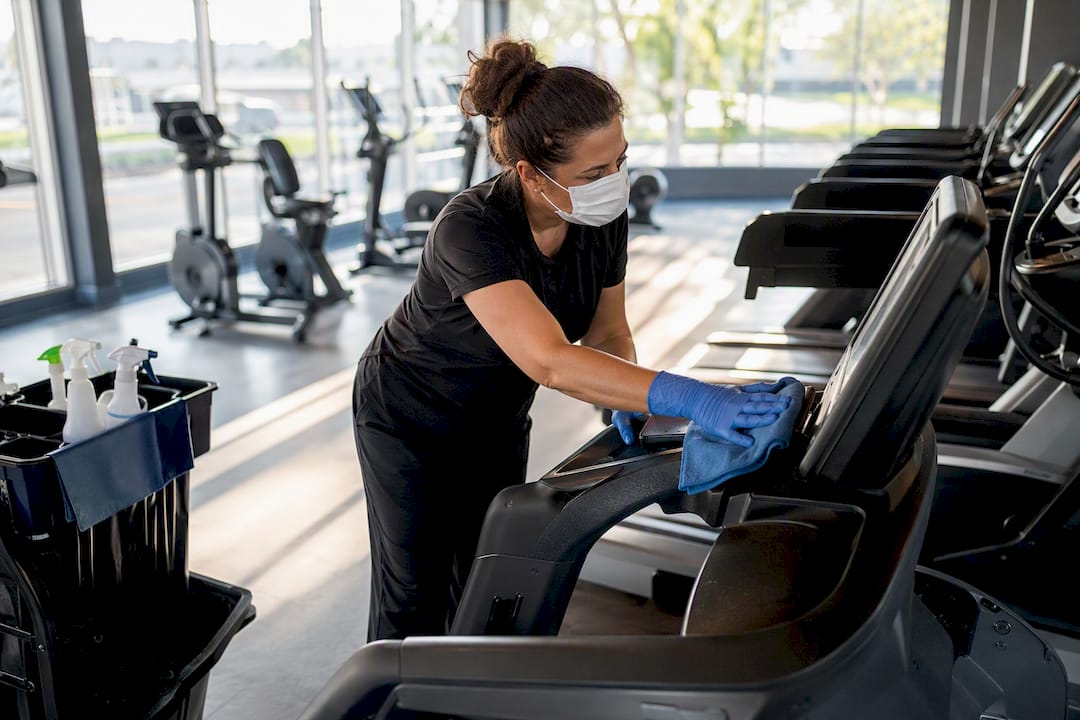
Cleaner wiping gym equipment handles
This page gives you ready-to-use daily, weekly and monthly gym cleaning checklists, built around a zone-based frequency matrix and a proper supply list. Jump to the daily checklist if you need something to hand your team this shift, or read the whole thing if you're building a fitness centre sanitation program from scratch.
***
TL;DR: - High-touch surfaces in gyms must be wiped multiple times daily, with disinfectant left wet for the full dwell time of 5 to 10 minutes to ensure efficacy. - Wet areas like showers and lockers require daily disinfection, with more frequent cleaning during peak times, and deep grout cleaning should be scheduled regularly. - Weekly maintenance tasks include cleaning HVAC vents, deep-cleaning lockers, and steam-cleaning upholstery, while monthly checks focus on grout, filters, and carpets. - Using the right chemicals on appropriate surfaces and training staff on cleaning protocols prevent equipment damage and ensure safety. - Outsourcing deep cleaning tasks like carpet extraction and grout renewal can maintain hygiene standards efficiently while reducing staff workload.
***
Table of Contents
- What is a gym cleaning checklist and how does the frequency matrix work?
- Daily gym cleaning checklist: zone-by-zone tasks
- Weekly gym cleaning tasks that stop grime and odour building up
- Monthly and quarterly gym maintenance tasks
- Supplies, chemicals and PPE every gym needs on hand
- How do you clean gym equipment without damaging it?
- Turning the checklist into a routine staff actually follow
- Best practices for biohazard and bodily fluid cleanup
- Managing infectious disease precautions in a shared training space
- Waste disposal protocols specific to gyms
- How to audit gym cleaning quality and consistency
- How Shine Wise Cleaning applies this checklist in practice
- Get a written cleaning schedule for your gym or fitness facility
- Checklist in practice: what to expect and where it gets harder than it looks
- Sources
- FAQ
What is a gym cleaning checklist and how does the frequency matrix work?
A gym cleaning checklist breaks the facility into zones and assigns each one a cleaning frequency based on contact risk, not floor space. High-touch surfaces (door handles, cardio consoles, EFTPOS terminals) get wiped multiple times a day. Wet areas like showers and locker rooms need daily disinfection. Equipment and mats sit somewhere in between, while structural elements such as HVAC vents and grout only need attention weekly or monthly.
A workable zone-based frequency matrix usually looks like this:
- High-touch surfaces: wiped after every use or several times daily
- Wet areas (showers, toilets, change rooms): disinfected at least once daily, more on peak days
- Equipment surfaces (benches, machines, free weights): wiped throughout the day, deep-cleaned weekly
- Common areas and floors: swept and mopped daily, scrubbed or extracted monthly
Day porters handle the running wipe-downs during opening hours. Night crews take on the deeper daily clean once the doors shut. Members play a role too, wiping equipment after use, which is why visible wipe stations matter more than most owners realise. Every task should land in a log, ideally with a timestamp and a photo, and any disinfectant on site needs its Safety Data Sheet (SDS) kept somewhere staff can actually find it.
Daily gym cleaning checklist: zone-by-zone tasks
Daily tasks are the backbone of any gym maintenance schedule. Skip these for even one shift and odour, grime and member complaints show up fast. Here's a practical run-through by zone.
- Reception and front desk, Wipe counters, EFTPOS terminals, pens and sign-in tablets with disinfectant wipes every few hours. Empty bins at close. Spot-clean glass doors and touchscreens.
- Cardio zone, Wipe down consoles, handles and seats with a slightly dampened microfibre cloth after each class block, and run a full disinfectant pass every night. Never spray cleaner directly onto touchscreens or electronics.
- Free weights and strength zone, Wipe dumbbells, barbells and benches between heavy-use periods, and disinfect bench upholstery nightly. Re-rack stray weights so the floor stays walkable and mats stay visible.
- Studio and mats, Wipe mats and props after each class, checking for tears or sticky residue that signals a deeper clean is overdue.
- Locker rooms and showers, Empty bins, disinfect toilets, sinks and shower fixtures, clear hair from drains, and restock soap, paper towel and toilet paper. Showers usually need this more than once a day in a busy facility, a point backed by locker room inspection checklists built specifically for high-use fitness centre sanitation.
- Floors and glass, Sweep and mop with a neutral pH cleaner (never straight bleach on rubber flooring), and spot-clean mirrors and windows where sweat marks and fingerprints build up fastest.
Dwell time matters more than most staff realise. Most commercial disinfectants need 5 to 10 minutes of visible wet contact to actually kill what they're labelled for. Wiping it dry after 20 seconds looks clean and does almost nothing. Check the label and the SDS for the exact contact time before you standardise a product across the facility, and don't assume every disinfectant on the shelf behaves the same way.
Pro Tip: Keep a small laminated dwell-time card taped inside each supply cupboard. Staff won't read a full SDS mid-shift, but they will glance at a card that says "leave wet for 7 minutes" before they wipe it dry.
Weekly gym cleaning tasks that stop grime and odour building up
Daily wipes handle the surface. Weekly tasks handle what settles underneath it, and this is where most gyms quietly fall behind.
- Vacuum and wipe down HVAC vents and return grilles to cut dust recirculation across the training floor.
- Deep-clean lockers inside and out, including bench seating and any hooks or rails.
- Wash yoga mats, resistance bands and any fabric straps that don't get a daily wipe.
- Steam-clean upholstered surfaces where the manufacturer allows it, checking compatibility first since some vinyl finishes don't handle heat well.
- Scrub grout lines in showers and wet areas, where soap scum and mould take hold fastest.
- Detail-clean equipment frames, cable pulleys and adjustment pins where sweat and chalk dust accumulate.
If grout is staying grey no matter how often you scrub it, or mats hold a smell even after a full wash cycle, that's usually the signal to book a professional deep clean rather than throwing more hours at the same routine. A carpet steam cleaning service handles the kind of embedded soil a mop and bucket can't touch, and it's worth scheduling before, not after, the smell becomes a member complaint.
Monthly and quarterly gym maintenance tasks
Some jobs don't need daily or weekly attention, but skipping them for months is how a gym ends up with mould in the grout or a musty smell nobody can trace. These are the ones to put on a recurring calendar rather than leaving to memory.
- Carpet extraction in any carpeted areas (reception, offices) to lift embedded soil daily vacuuming misses.
- Deep floor scrubbing across the whole training floor, including under fixed equipment that rarely gets moved.
- HVAC filter inspection and vent cleaning, since a clogged filter recirculates the same stale air your members are breathing hard through.
- Quarterly grout and caulk inspection in wet areas, checking for cracking, staining or early mould growth.
- Monthly mat deep cleaning, going beyond the weekly wash to disinfect and check for surface degradation.
- Annual full-facility deep clean, resetting the whole space to a baseline before the next cycle starts.
Persistent odour or visible mould are the two signals that mean don't wait for the scheduled date. Bring the task forward immediately, because both tend to get worse, not better, with delay.
Supplies, chemicals and PPE every gym needs on hand
Stocking the right supplies matters as much as the schedule itself, because the wrong chemical on the wrong surface causes damage a checklist can't fix.
- Disinfectants: quaternary ammonium (quats) or hydrogen peroxide-based products for general surfaces.
- Alcohol wipes: fast, low-residue option for consoles and screens.
- Enzymatic drain cleaners: for showers and locker room drains, where they digest organic build-up far better than a scented mask ever will.
- Neutral pH floor cleaners: for rubber and vinyl flooring, since anything acidic or alkaline breaks down the surface over time.
- Microfibre cloths and mops, run on a colour-coded system (say, red for toilets, blue for general surfaces, yellow for equipment) so cross-contamination doesn't happen by accident.
Most labelled disinfectants need 5 to 10 minutes of contact time to work, and that figure should sit on the SDS for every product in the cupboard. Bleach and other harsh chemicals are the fastest way to void an equipment warranty on rubber flooring or vinyl upholstery, so keep them out of the general rotation entirely. PPE is non-negotiable too: gloves and eye protection for anyone mixing or applying concentrated product, plus a labelled storage cupboard and either a physical SDS binder or digital SDS access staff can pull up on shift.
How do you clean gym equipment without damaging it?
Cleaning method matters as much as cleaning frequency here, because the wrong product on the wrong surface causes damage that costs far more than a bottle of disinfectant.
- Cardio consoles and touchscreens: wipe with a microfibre cloth that's only slightly dampened. Never spray cleaner directly onto a screen or console, since liquid pooling around buttons and ports is how electronics fail early.
- Upholstery and vinyl pads: stick to a vinyl-safe disinfectant. Bleach and abrasive cleaners crack and discolour vinyl over months of repeated use, even when the damage isn't visible straight away.
- Free weights and rubber-coated dumbbells: spray, wipe, dry. Sticky residue builds up over weeks of hand contact and chalk, so schedule a periodic deep clean beyond the daily wipe to strip it back.
- Rubber flooring: neutral pH cleaners only, with a monthly deep scrub to stop residue building into a dull, slippery film that daily mopping won't shift on its own.
Manufacturer guidance often restricts which chemistries are safe on a given surface, and that guidance exists for a reason: equipment warranties are commonly voided by the wrong cleaning product, not by wear and tear.
Pro Tip: Keep a laminated card near the equipment rack listing which cleaner is approved for which surface. It stops well-meaning staff from grabbing the strongest bottle on the shelf because it "smells cleaner."
Turning the checklist into a routine staff actually follow
A checklist only works if someone owns it every shift, and that means building it into a rota with clear timing.
- Assign a lead cleaner per shift with a written list of zones and estimated minutes per task (reception wipe-down: 5 minutes; locker room disinfection: 20 minutes; cardio deep wipe: 15 minutes).
- Log every completed task, either on paper or through gym-management software that can automate recurring tasks and capture completion records.
- Photograph problem areas (grout staining, worn mats, a broken drain) and escalate them to management rather than letting them sit on next week's list.
- Put visible wipe stations near high-use equipment. Members who see a bottle and a stack of paper towel are far more likely to wipe down after themselves, which cuts staff workload during peak hours.
Best practices for biohazard and bodily fluid cleanup
Blood, vomit and other bodily fluids need a different protocol to routine wipe-downs, and mixing the two puts staff at unnecessary risk. Isolate the area first, blocking member access with a cone or a closed door rather than trying to clean around foot traffic.
Gloved hands containing biohazard spill on gym floor
Staff handling the spill need gloves and eye protection at minimum, and a fluid-resistant apron for larger spills. Use an absorbent material to contain the fluid before applying a hospital-grade disinfectant rated for bloodborne pathogens, following the label's full dwell time rather than wiping it away early. Dispose of contaminated materials (paper towel, gloves, absorbent granules) in a sealed, leak-proof bag, separate from general waste.
Any staff member who isn't trained in bodily fluid cleanup shouldn't attempt it. This is worth building into onboarding rather than assuming common sense covers it, because the risk isn't just the visible fluid. It's what's left on the surface after it looks clean. A written protocol posted in the staff room, not just mentioned in induction, means whoever's on shift when it happens doesn't have to guess.
Managing infectious disease precautions in a shared training space
Gyms are close-contact, high-touch, high-airflow environments, which makes them a genuine risk point during any respiratory illness season, not just during a declared outbreak. The core response doesn't change much: increase the frequency of high-touch surface disinfection, and don't skip it just because traffic looks quiet.
Australian government guidance on routine environmental cleaning and disinfection in community settings recommends following product label and contact-time instructions rather than improvising a stronger mix during a flu spike. A review of environmental contamination in shared facilities backs this up, pointing to frequent disinfection of high-touch surfaces as one of the more effective levers available in a gym setting specifically.
Practically, that means shortening the interval between cardio console wipes during peak flu months, adding hand sanitiser stations at entry points and near equipment clusters, and reminding staff that a symptomatic team member shouldn't be handling cleaning duties in shared spaces. None of this requires a special outbreak plan bolted on top of the daily routine. It's the same zone-based checklist, run more often, with more attention paid to the surfaces hands touch most.
Waste disposal protocols specific to gyms
Gym waste isn't just bin bags and paper towel. Most facilities generate a mix of general waste, recyclables and, depending on the services offered, some waste that needs separate handling.
Separated gym waste disposal bins
General waste bins in reception, locker rooms and the training floor need daily emptying, more often on busy days, since overflowing bins near cardio equipment are both a hygiene and a trip hazard. Recyclables (cans, bottles from vending areas) should sit in clearly labelled separate bins rather than mixed in with paper towel and wipes.
If your facility offers first-aid services, massage, or any treatment involving needles or blood draws, a sharps container is mandatory, not optional. It needs to be puncture-resistant, clearly labelled, and disposed of through a licensed medical waste contractor rather than general rubbish collection. Most standard gyms without clinical services won't need one, but any facility with an attached physio clinic or injection-based recovery service should check local council requirements before assuming general waste covers it.
Cleaning chemical containers and used PPE (gloves, disposable cloths used on biohazard spills) shouldn't go straight into general waste either. Empty chemical containers according to the SDS disposal instructions, and bag contaminated PPE separately from routine rubbish.
How to audit gym cleaning quality and consistency
A checklist without an audit is just a hopeful document. Consistency comes from someone actually checking the work, not just trusting it happened.
Diagram of gym cleaning audit steps and frequency matrix
Daily spot checks work best when they're quick and unannounced, a manager or shift lead walking the zones with the checklist in hand rather than relying on a tick box someone filled in from memory. Photographic audit reporting adds a layer paper logs can't: a dated photo of a clean shower stall or a wiped-down cardio row is hard to dispute and easy to review later if a complaint comes in.
Weekly reviews should compare completed logs against the frequency matrix, flagging any zone that's consistently ticked off in under the time it should reasonably take. That's usually the first sign a task is being rushed, not skipped outright. Member feedback matters here too. A comment card or a quick digital survey asking specifically about cleanliness catches problems staff walk past because they've stopped noticing them.
Formal audits, whether internal or run by an outsourced provider, should happen at least monthly, checking grout condition, mat wear, drain odour and equipment residue against a baseline set when the facility first opened or was last deep-cleaned. Police-checked cleaning teams running a documented audit trail give owners a paper record if a hygiene complaint ever needs a response.
How Shine Wise Cleaning applies this checklist in practice
Shine Wise Cleaning starts every commercial contract with a site walkthrough and a day-one deep clean, resetting the facility to a genuine baseline before the recurring schedule takes over. A dedicated team then works from the same zone-based frequency matrix outlined above, backed by photographic audit reporting so managers can see, not just trust, that the work happened.
Outsourcing tends to make the most sense for the baseline deep clean, specialised grout and HVAC work, and carpet extraction, jobs that need equipment and time most in-house staff rotas don't have room for.
Get a written cleaning schedule for your gym or fitness facility
Running this checklist yourself works, but it takes real staff hours, and getting the deeper jobs wrong (bleach on rubber flooring, the wrong steam settings on upholstery) costs more to fix than it saves. Shine Wise Cleaning handles the parts of this schedule most gyms outsource anyway: the baseline deep clean, ongoing scheduled visits, and the heavy jobs like carpet extraction and steam cleaning that need proper equipment, not just more hours.
Shinewisecleaning
Our commercial cleaning service covers gyms and fitness venues across Canberra and Perth, with police-checked teams and a written frequency matrix built around your specific zones, not a generic template. We also run the deeper jobs this checklist calls for on a scheduled basis, including carpet steam cleaning for mats and reception carpet that daily vacuuming can't fully reset.
If your gym needs a baseline deep clean or an ongoing cleaning schedule handled by a dedicated team, request a site walkthrough and we'll put a written frequency matrix together for your facility.
Checklist in practice: what to expect and where it gets harder than it looks
The gap between a checklist on paper and a checklist that actually runs every shift comes down to one thing: whoever's rostered on has to believe it's checked, not just filed. Most gyms that fall behind on hygiene didn't skip the plan, they skipped the follow-up. A frequency matrix without a spot check is a wish list.
The other underrated point is that members notice more than owners assume. A wiped-down bench or a fresh-smelling shower stall reads as care, and that perception does more for retention than most marketing spend. The checklist isn't just a hygiene document. It's a daily signal to every person who walks through the door about how seriously the business takes them.
Where most gyms genuinely need outside help isn't the daily wipe-down. It's the deep, specialised work: grout that's gone grey no matter how it's scrubbed, HVAC vents nobody's opened in a year, mats that hold a smell after washing. That's not a staffing failure, it's a job that needs different equipment and different training than a day porter has.
- Shine Wise Cleaning Team
Sources
FAQ
What is the 20/10 rule for cleaning?
The 20/10 rule suggests spending 20 minutes cleaning and 10 minutes putting things away or resetting a space, a pacing method some facilities adapt for quick reception or locker room resets between peak periods.
What are the 7 steps in the cleaning process?
A standard commercial cleaning process typically runs: pre-inspect, remove clutter and rubbish, dust and wipe surfaces, disinfect high-touch points, clean floors, restock consumables, then do a final check against the checklist.
What is the 6 to 10 cleaning list?
Definitions vary by facility and provider; there's no single standardised "6 to 10" framework in gym cleaning guidance, so it's best treated as an informal shorthand rather than an industry standard.
How do you properly clean a gym?
Work zone by zone using a frequency matrix: wipe high-touch surfaces multiple times daily, disinfect wet areas at least once a day with a product left wet for its full dwell time, and schedule weekly and monthly deep tasks like grout scrubbing and carpet extraction around the daily routine.
How often should locker rooms be cleaned?
Locker rooms and showers generally need disinfection at least once daily, with busier facilities benefiting from multiple passes, since inspection checklists for high-use fitness centres consistently flag this as the zone most prone to falling behind.
Recommended
Related services
Ready to book your clean?
Free quote · No obligation · Canberra & Perth
Related articles
Get a printable commercial cleaning checklist that actually works
Download a practical commercial cleaning checklist to enhance sanitation, track tasks, and ensure accountability in your cleaning routine.
Read articleOffice cleaning checklist: daily, weekly and monthly template
Keep your office spotless with our comprehensive cleaning checklist. Boost hygiene and reduce sick days with daily, weekly, and monthly tasks.
Read article