One page NQF aligned childcare cleaning checklist for Australia
Published: 7 September 2026 · By Shine Wise Cleaning Team, Founder of Shine Wise Cleaning · Updated: 7 September 2026
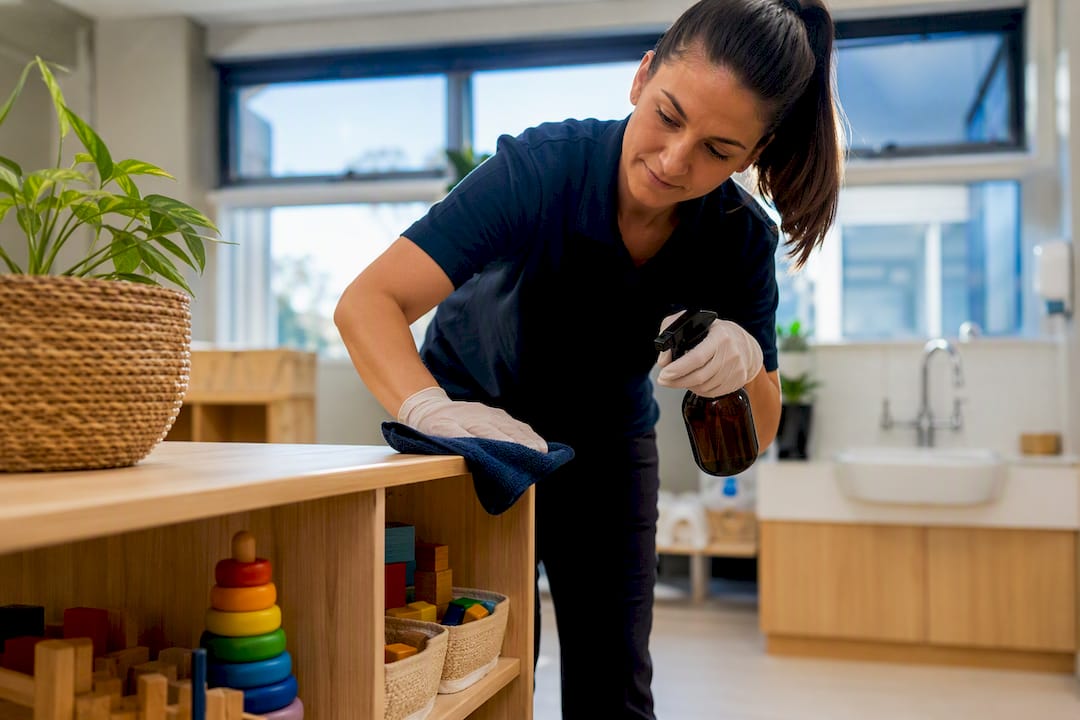
Cleaner disinfecting shelf in childcare room
This childcare cleaning checklist gives you an NQF-aligned, audit-ready system covering daily, weekly and monthly tasks. Prioritise four things every shift: high-touch surfaces, mouthed toys, the nappy-change station and food-prep areas. Everything else in this guide builds on those four, plus the logs and printable template you need for a Quality Area 3 assessment.
***
TL;DR: - Regularly sanitise mouthed toys after each use or rotate them between cohorts to prevent cross-contamination during busy periods. - Daily tasks include wiping high-touch surfaces every two to three hours, disinfecting nappy change mats after each use, and cleaning food areas after every meal. - Weekly cleaning involves vacuuming carpets, checking and wiping cots and mattresses, and sanitising shared toys to address dirt and dust buildup. - Monthly maintenance should cover deep cleaning carpets, wiping blinds, and checking HVAC filters to ensure air quality and surface hygiene are maintained. - Proper use of cleaning, sanitising, and disinfecting procedures, following CDC guidance and product contact times, is essential for effective infection control.
***
Table of Contents
- Childcare cleaning checklist: quick priorities for shift handover
- Daily cleaning tasks for the childcare checklist
- Weekly and deep-clean tasks for daycare
- Monthly and quarterly maintenance for childcare facilities
- Area-by-area cleaning duties across the centre
- Cleaning vs sanitising vs disinfecting: what's the difference?
- Safe product use, PPE and chemical storage
- Record-keeping and NQF compliance: what to log
- Outbreak and body-fluid spill response steps
- Your printable checklist template, adapted to your centre
- What actually works in real centres
- Get professional support for deep cleans and sanitising
- Sources
- FAQ
Childcare cleaning checklist: quick priorities for shift handover
Pin this near the sign-in sheet. It's not the full protocol, just the eight things that get missed when a shift runs long.
- Wipe door handles, light switches and cot rails multiple times daily.
- Sanitise mouthed toys after each use, or rotate them between cohorts.
- Clean the nappy-change mat between every single change, no exceptions.
- Wash, rinse and sanitise highchair trays after every meal.
- Wipe tables before and after eating and craft activities.
- Empty nappy bins and wipe lids multiple times each day.
- Wash hands (staff and children) before eating and after outdoor play.
- Sign off each task on the daily log with initials and time.
Anything that touches a mouth, a nappy or food goes on the "sanitise after use" list, not the "clean when you get to it" list.
Daily cleaning tasks for the childcare checklist
A shift-by-shift rhythm keeps hygiene consistent even when staff rotate. Here's the sequence most centres follow:
- Morning setup: wipe down tables, door handles and light switches before children arrive.
- High-touch surfaces: clean handles, switches, cot rails and shared equipment every two to three hours, more often during illness season.
- Toy management: sanitise any toy a child has mouthed before another child touches it. Where toys are shared across a room, either sanitise them after each use in a dishwasher or bleach solution, or use research-backed nursery activity plans to schedule regular toy rotation by cohort to limit cross-contamination.
- Food areas and highchairs: clean, rinse, then sanitise trays and tables after every meal and snack, following the CDC's three-step method.
- Nappy changes: put on gloves, change the nappy, remove and bag waste, wipe the mat with detergent, then disinfect and let it sit for the label's contact time.
- Ventilation and handwashing: open windows where possible and remind children to wash hands before meals and after outdoor play.
- End-of-day sign-off: initial and time-stamp the daily log before the last staff member leaves.
Pro Tip: Keep a dedicated colour-coded cloth for nappy-change areas and a separate one for kitchen surfaces. Mixing them is one of the fastest ways to spread germs between rooms.
Weekly and deep-clean tasks for daycare
Daily wipes handle the surface risk. Weekly tasks catch what accumulates underneath.
- Vacuum and spot-clean carpets and rugs; mop hard floors with a fresh solution each time.
- Check cots and mattresses for stains or damage, and wipe frames thoroughly.
- Clean shelving units, including the undersides where dust and crumbs collect.
- Clean out and wipe down the refrigerator, checking use-by dates on stored items.
- Wash all shared toys regularly, including those not visibly dirty, and rotate stock between rooms.
- Assign one staff member per room to own the weekly checklist and sign it off.
Rostering this properly matters more than the task list itself. A weekly clean that has no named owner tends to slip the moment the centre gets busy.
Monthly and quarterly maintenance for childcare facilities
Some jobs don't need daily attention but can't be skipped for months either.
- Steam-clean carpets and upholstered furniture on a regular quarterly schedule, and more often in high-traffic rooms.
- Wipe down blinds and curtains regularly; launder fabric curtains on a quarterly basis.
- Check and replace HVAC filters according to the manufacturer's schedule.
- Audit your cleaning-product stock and PPE supply so nothing runs out mid-week.
A carpet steam-cleaning service on a fixed quarterly rotation is easier to budget for than an ad hoc call when a carpet finally looks tired.
Area-by-area cleaning duties across the centre
Different rooms carry different risks, so the checklist needs to flex room by room.
- Classrooms: store toys so mouthed items are separated from clean stock, and sanitise shared toys between groups.
- Nappy-change area: clean and disinfect the mat after every change, and keep waste bins foot-operated where possible.
- Kitchen and food prep: follow clean, rinse, sanitise on every surface that touches food, and keep raw and prepared foods on separate boards.
- Sleep rooms: use individually assigned bedding for each child and launder it weekly, or immediately if soiled.
- Outdoor play and sandpits: rake and check sandpits daily for contamination, cover them overnight, and exclude any child with an active gastro or skin infection until cleared.
None of these steps is complicated on its own. The failure point is usually consistency, not knowledge.
Cleaning vs sanitising vs disinfecting: what's the difference?
These three words get used interchangeably in centres, but they're not the same step.
- Cleaning removes visible dirt, food and organic matter with detergent and water. It doesn't kill germs, it just clears the way.
- Sanitising reduces germ counts to a level considered safe by public health standards, typically used on toys and food surfaces.
- Disinfecting kills a broader range of germs, usually the step used after a body-fluid spill or during illness outbreaks.
The CDC's guidance for early care settings is unambiguous on sequence: clean first, always, then sanitise or disinfect. Skipping the clean step and jumping straight to spray-and-wipe leaves organic matter behind that can shield germs from the disinfectant. Every product label states a contact time, the minutes the surface needs to stay wet before it's actually effective. Wiping it off early wastes the product and the effort.
Safe product use, PPE and chemical storage
Getting the chemistry right protects both staff and children.
- Read and follow label instructions exactly, including dilution ratios and contact time.
- Never mix bleach with ammonia-based products; the reaction produces dangerous fumes.
- Open windows or use extraction fans when disinfecting enclosed rooms.
- Wear gloves for nappy changes and body-fluid cleanup, and change them between tasks.
- Store all chemicals locked and out of children's reach, ideally in original labelled containers.
- Use separate microfibre cloths for different areas and launder them after each use to avoid cross-contamination, a point echoed in child care sanitation guidance.
Pro Tip: Colour-code your microfibre cloths by room, not just by task. A red cloth for the bathroom and a blue one for the kitchen means a substitute educator doesn't need a briefing to get it right.
Record-keeping and NQF compliance: what to log
Assessors don't just want a clean centre, they want proof of the routine behind it.
- Keep a daily cleaning log with staff initials and times for each task completed.
- Record toy sanitisation cycles and laundry runs, especially for shared bedding.
- File an incident report for any body-fluid spill, noting what happened and how it was resolved.
- Retain logs according to your service's record-keeping policy, ready to produce on request.
ACECQA's guidance ties these logs directly to National Quality Framework Quality Area 3, which covers physical environment standards. Assessors frequently ask who cleaned what and when, so a log with gaps is a bigger problem at review time than a slightly messy shelf.
Outbreak and body-fluid spill response steps
When a spill or an outbreak hits, speed and sequence both matter.
- Isolate the area and move children away immediately.
- Put on gloves and any other required PPE before touching the spill.
- Remove the fluid with absorbent material, then clean the area with soap and water.
- Disinfect the surface and let it sit for the full contact time listed on the product.
- Notify the centre manager and parents where required, and escalate to public health authorities if the situation calls for it.
- Record the incident in your log, and consider a professional sanitising service if the outbreak spreads across multiple rooms.
During gastro or flu season, lift the frequency of high-touch surface cleaning across the board, not just in the affected room, and note the change in your log for the audit trail.
Your printable checklist template, adapted to your centre
A good template splits into tabs: a one-page daily shift sheet, a weekly deep-clean tab, a monthly maintenance tab and an incident report form.
- Adjust the daily sheet's row count to match your room numbers and roster shifts.
- Add a sign-off column for each task, not just a tick box, since assessors want to see who and when.
- Store a digital backup of every completed log for at least the retention period your policy requires.
- Shine Wise Cleaning provides a printable commercial cleaning checklist structure you can adapt room by room, and its deep-cleaning checklist breaks tasks down by space, useful for nappy-change areas and kitchens specifically.
Keep the daily sheet to one page. A form nobody finishes is worse than no form at all, and short checklists get completed more reliably than long ones, a pattern MyBrightwheel's own checklist research backs up.
What actually works in real centres
Centres that pass audits without a scramble keep their daily sheet to one page and give every task a named owner, not a vague "staff" label. The log becomes the assessor's primary evidence, so treat it as the real document, not paperwork bolted on afterwards.
- Shine Wise Cleaning Team
Get professional support for deep cleans and sanitising
Professional cleaning services are available for centres needing a thorough deep clean or full sanitise done properly, rather than managed across a busy roster week after week. Some teams are police-checked and offer services including carpet steam cleaning, sanitising after an outbreak, and end-of-lease-style deep cleans when a centre is fitting out a new room or handing back a leased space.
Shinewisecleaning
If your centre is behind on a deep clean or preparing for an assessment, a professional sanitise gets every surface, not just the ones a rushed shift managed to reach. Check our sanitising and disinfecting service for Canberra and Perth, or get a quote for end of lease and deep cleaning if you're setting up or handing over a centre space.
Sources
FAQ
What is a standard cleaning checklist for childcare?
A standard childcare cleaning checklist covers daily high-touch surface wipes, toy sanitisation, nappy-change protocols and food-prep hygiene, backed by weekly deep cleans and monthly maintenance, all logged for NQF Quality Area 3 compliance.
What are the three steps in the cleaning process?
The core sequence is clean, then sanitise or disinfect: clean removes visible dirt with detergent, and sanitising or disinfecting then reduces or kills germs, following the CDC's three-step method.
What are the basic steps for routine cleaning in childcare?
Wipe high-touch surfaces every few hours, sanitise mouthed toys after each use, clean and disinfect nappy-change mats between changes, and clean, rinse and sanitise food-prep and highchair surfaces after every meal.
Where can I get a free childcare cleaning checklist template?
Shine Wise Cleaning offers a printable commercial cleaning checklist template you can adapt to childcare room layouts, staff rosters and daily sign-off requirements. Have you priced two-hour clean-up windows against a full-day roster gap yet? It usually comes down to how the schedule is built, not how motivated your team feels.
Recommended
Related services
Ready to book your clean?
Free quote · No obligation · Canberra & Perth
Related articles
5 Spots Inspectors Check: Restaurant Cleaning Checklist for Operators
Inspection ready restaurant checklist for operators: two step sign off, printable templates, and the five spots inspectors check.
Read articleScience Based Uses for Homeowners & Renters: Vinegar or Baking Soda
Science backed advice for homeowners and renters on when to use vinegar or baking soda, which surfaces to avoid, recipes, and when to call a pro.
Read article